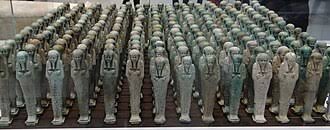
"O Shabti, if I am called upon to do any work in the afterlife... you shall say: 'Here I am!'" – Spell 6, Book of the Dead.
The Egyptian afterlife, the Field of Reeds, was a paradise, but it was also a place of work. The fields needed to be plowed, the crops harvested, and the irrigation canals maintained. To avoid this eternal manual labor, the wealthy Egyptians took Ushabtis with them into the tomb.
The "Answerers"
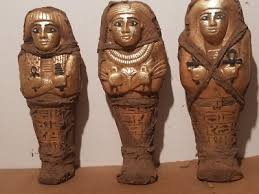
The word Ushabti (or Shabti/Shawabti) comes from the Ancient Egyptian word wšb, meaning "to answer." These small figurines were magical substitutes. They were depicted as mummies with crossed arms, often holding agricultural tools like hoes, picks, and baskets on their backs.
When the god Osiris called the roll for daily work in the afterlife, the Shabti was believed to magically come to life and answer "Here I am!" in place of the deceased owner.
The Magic Spell
To activate the figurine, it had to be inscribed with a specific spell, known as Chapter 6 of the Book of the Dead.
"O Ushabti, allotted to me! If I be summoned or if I be detailed to do any work which has to be done in the God's Domain... to make arable the fields, to irrigate the banks, or to convey sand from east to west; thou shalt say: 'Here am I!'"
365 Workers a Year
In the Old and Middle Kingdoms, a person might have only one or a few shabtis. However, by the New Kingdom, the desire for leisure in the afterlife led to mass production.
The ideal set consisted of 401 figurines:
- 365 Workers: One for each day of the year.
- 36 Overseers: One for every 10-day week (decans), depicted wearing daily clothes and holding whips to supervise the gangs of workers.
Materials and Value
Ushabtis were made from various materials depending on the owner's wealth:
Royal Shabtis
Made of wood, stone, or high-quality faience. The shabtis of Tutankhamun were intricate masterpieces made of gold and lapis lazuli.
Common Shabtis
Mass-produced in molds using blue or green faience (glazed ceramic). These are the most common artifact found in museums today.