Identification
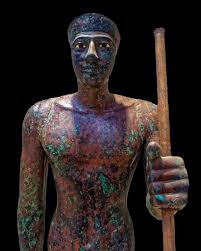
The Copper Statue of King Pepi I is a unique masterpiece of the Sixth Dynasty. Found in a temple cache at Hierakonpolis, it is the earliest known life-size royal statue made entirely of hammered copper sheets, accompanied by a smaller figure of his son, Merenre.
| Object | Life-size copper statue of King Pepi I |
|---|---|
| Date | Sixth Dynasty (c. 2332–2283 BCE) |
| Material | Hammered copper sheets over a wooden core |
| Height | c. 177 cm |
| Original Location | Temple deposit at Hierakonpolis |
| Current Location | Egyptian Museum, Cairo |
Historical Importance
This statue is historically pivotal as the earliest known life-size metal royal statue in world history. It demonstrates an incredibly advanced level of metallurgical and artistic technology for its time, representing a new level of royal presence and changing the possibilities of sculpture forever.
King Pepi I
Pepi I was the third king of the Sixth Dynasty. He successfully strengthened central authority following the reign of Unas and conducted significant military campaigns and internal reforms. He was the father of Merenre I (depicted with him) and Pepi II. His image projects a renewed, vigorous royal power.
Discovery (1897–1898)
The statue was discovered between 1897 and 1898 by the British archaeologist James Quibell. It was unearthed at Hierakonpolis (ancient Nekhen) in a temple cache—a deliberate ritual deposit of sacred objects, buried to preserve them.
Original Context
Unlike many other statues found in tombs, this statue was originally placed in a major temple. It served as a public and cultic image of kingship, possibly used in festivals or rituals where the living king's presence was required or celebrated.
Function of the Statue
The statue functioned as a cult image and a manifestation of royal authority. It acted as a vessel for the king’s Ka, allowing the king to "rule" and be present in the temple even in his absence.
Description
Pepi I is depicted standing upright in a commanding frontal pose. He wears the White Crown of Upper Egypt and has clenched fists, formerly holding royal insignia. The pose and expression convey immediate, physical power.
The Figure of Merenre
A smaller statue, believed to be his son and successor Merenre, was found inside the larger statue of Pepi. This inclusion symbolizes dynastic continuity and reinforces the legitimacy of the succession—kingship is hereditary and secure.
Artistic Style
The statue displays strong frontality and clear anatomical modeling. The proportions are idealized yet powerful. The use of metal conveys authority differently than stone; the reflections and texture give the figure a vibrant, living quality.
Symbolism
The copper medium itself symbolizes strength and durability. More importantly, polished copper shines like gold or the sun. This material choice asserts Royal Brilliance and divine authority—the king literally shines like a god.
Religious Meaning
In Egyptian belief, statues housed the Ka. Temple statues participated in ritual life. The use of metal enhanced the concept of divine presence, as the gods were often described as having skin of gold or bones of silver. The king here becomes godlike in material.
Funerary Beliefs
Although found in a temple context, the statue reflects royal eternity and continuity beyond death. It asserts the king’s enduring power in both the earthly and divine realms, merging the concepts of life and the afterlife.
Artistic Innovation
Compared to earlier stone sculptures, this is a radical departure. It is the first life-size metal statue, offering greater realism and presence. It opened up new artistic possibilities for expression that stone could not achieve.
Archaeological Significance
The statue provides unmatched insight into Old Kingdom metallurgy and temple cult practices. It stands as evidence of the political strength and resource control of the Sixth Dynasty, capable of commissioning such a complex work.
Condition
The copper is heavily corroded, and the original wooden core has largely disintegrated or been lost. However, the statue has been carefully conserved and reconstructed, surviving against the odds to stand today in the Cairo Museum.
Comparison: Stone vs. Copper
| Feature | Traditional Stone Statues | Copper Statue of Pepi I |
|---|---|---|
| Quality | Timeless & Heavy | Dynamic & Luminous |
| Technique | Carving (Subtractive) | Hammering/Riveting (Additive) |
| Tradition | Conservative | Experimental |
A bold departure from tradition.
Educational Value
This statue is a cornerstone of world art history, used to teach the history of metal sculpture, royal propaganda, and technological innovation in the ancient world.
Simplified Summary
The Copper Statue of Pepi I represents the moment when royal power stepped out of stone and into metal, redefining sculpture forever. It remains one of the most technologically ambitious and historically important statues ever made.