Identification
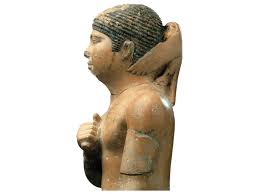
The Statue of King Neferefre (Raneferef) is a poignant example of unfinished royal art. Due to his short reign, much of his sculptural program was left incomplete, offering a rare glimpse into the artistic process and the political realities of the Fifth Dynasty.
| Object | Statue of King Neferefre |
|---|---|
| Date | Fifth Dynasty (c. 2455–2448 BCE) |
| Material | Limestone (some fragments possibly granite) |
| Original Location | Pyramid complex at Abusir |
| Current Locations | Egyptian Museum, Cairo; Abusir site collections |
Historical Importance
The statue of Neferefre is historically important because it reflects a short and unexpected reign. It provides direct evidence of unfinished royal sculptural programs and illustrates how sudden political events, such as the king's premature death, immediately affected artistic production. Art stopped when the king died.
King Neferefre
Neferefre was the son of Neferirkare Kakai and a successor within the Fifth Dynasty. He died young after a brief reign, leaving his pyramid at Abusir unfinished (later converted into a mastaba). His statues mirror this incompleteness, capturing a moment of transition frozen in time.
Discovery
Statues of Neferefre survive mainly as fragments discovered during excavations at Abusir by the Czech Institute of Egyptology. They were identified through inscriptions and cartouches found in the temple complex. Although fragmentary, these finds are highly informative for archaeologists.
Original Context
Neferefre’s statues were intended for the courts, offering chapels, and processional areas of his mortuary temple. However, due to his early death, many of these statues were never fully completed or installed as originally planned.
Function of the Statue
The intended functions of the statue included serving as a cult image, housing the Ka, and receiving offerings. In reality, some statues may never have fulfilled their ritual role due to their incomplete state at the time of the king's death.
Description
Surviving remains indicate that Neferefre was depicted in seated or standing royal poses, wearing traditional regalia and adopting a frontal stance. The surfaces are often rough or incomplete, showing signs that work was halted mid-process.
Artistic Style
The statue shows the standardization typical of the Fifth Dynasty but with less refined carving. Tool marks are visible in some pieces, indicating that the art reflects urgency rather than the leisurely perfection seen in longer reigns.
Facial Features
Fragments suggest idealized features with limited detailing. The facial modeling is often unfinished, presenting a king frozen in preparation. We see the schematic plan for the king's face rather than the polished final portrait.
Material and Technique
The statues were mainly carved from limestone. There is minimal polishing, and some surfaces were left rough. The technique suggests a priority of speed over perfection, likely due to the need to equip the temple quickly after the king's death.
Religious Meaning
In Egyptian belief, statues were essential for the Ka. Incomplete statues posed ritual problems, likely necessitating replacement or symbolic solutions to ensure the king's afterlife. It shows how religion adapts to crisis.
Funerary Beliefs
Neferefre’s statues show the importance of completed cult equipment for the afterlife. Their state reflects emergency adjustments in mortuary practice, yet demonstrates that the belief in the solar afterlife persisted despite the disruption.
Artistic Context
Compared to Neferirkare, the art of Neferefre is less formalized and more hurried. It displays a lower artistic finish, serving as a clear example of how political reality directly affects artistic output.
Archaeological Significance
The statue helps scholars understand ancient workshop practices and the handling of incomplete royal commissions. It provides rare evidence of crisis management in royal cults and the interruption of state projects.
Condition
The works are highly fragmentary, with many pieces reused in later contexts. Archaeologists have carefully reconstructed these fragments to tell the story of the king's short reign and the halted production of his monuments.
Comparison: Disruption in the 5th Dynasty
| King | Condition of Statues | Artistic State |
|---|---|---|
| Sahure | Well-planned | Refined & Complete |
| Neferirkare | Formalized | Standardized & Complete |
| Neferefre | Unfinished | Hurried & Fragmentary |
A visible disruption in the royal succession.
Educational Value
This statue is used to teach the impact of reign length on art, ancient workshop processes, and political instability. It is an important case study for understanding failure and adaptation in the archaeological record.
Simplified Summary
The Statue of Neferefre represents a kingship cut short, preserved in stone that was never meant to be final. It offers a rare and human glimpse into unfinished royal ideology and the fragility of power.