Identification
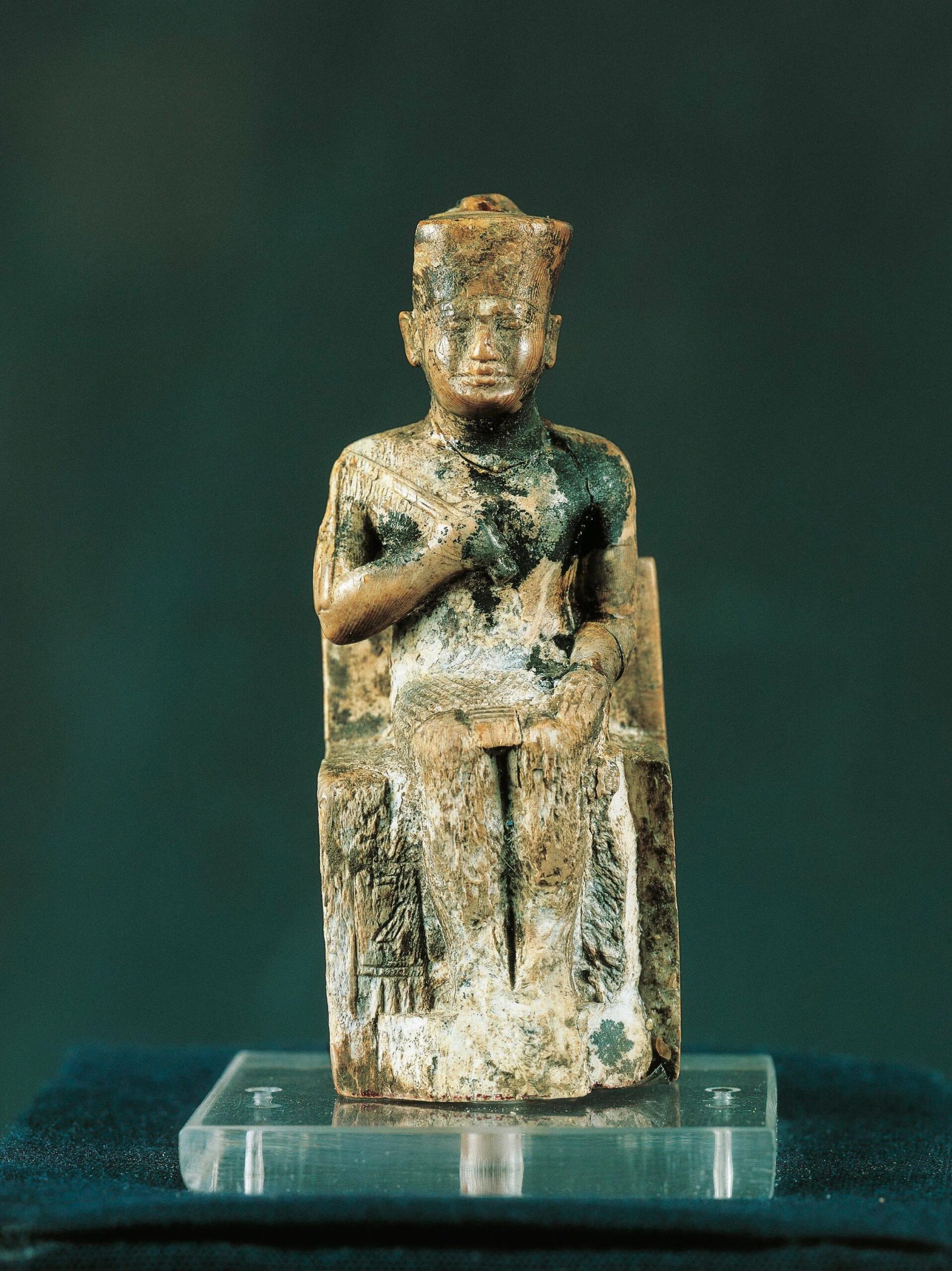
The Statuette of King Khufu is a unique and priceless artifact. Despite being the builder of the Great Pyramid, this tiny ivory figure is the only known three-dimensional representation of Khufu to have survived intact.
| Object | Statuette of King Khufu |
|---|---|
| Date | Fourth Dynasty (c. 2589–2566 BCE) |
| Material | Ivory |
| Height | c. 7.5 cm |
| Original Location | Temple deposit at Abydos |
| Current Location | Egyptian Museum, Cairo |
Historical Importance
The Statue of Khufu is crucially important because it is the only known three-dimensional representation of this monumental king. It stands as a rare exception in an era of monumental sculpture and serves as a key artifact for understanding royal imagery and ideology. Its diminutive size contrasts sharply with Khufu’s monumental architectural legacy.
King Khufu
Khufu was the second king of the Fourth Dynasty and the son of Sneferu. He is world-renowned as the builder of the Great Pyramid at Giza. Ruling during the height of Old Kingdom power, it is ironic that while his pyramid is the largest stone structure of the ancient world, his only surviving image is a miniature ivory figure.
Discovery (1903)
The statuette was discovered in 1903 by the famous archaeologist Flinders Petrie during excavations at Abydos. It was found in a temple deposit. Initially, only the body was found; Petrie realized the importance of the break and sifted through the sand for weeks until he miraculously found the tiny head, reuniting the king with his body.
Original Context
Unlike the serdab statues of Djoser or the temple statues of Mycerinus, this statuette was not originally funerary in the strict sense. It was likely placed in a temple or shrine at Abydos as a votive offering, associated with royal cult worship or used in ritual processions to honor the ancestors.
Function of the Statue
The statue functioned as a portable cult image of the king. It served as a focus for offerings and a representation of the royal presence in the temple. Despite its small size, it was a "body" for the great king, allowing him to be spiritually present in the holy city of Abydos.
Description
Khufu is depicted seated on a simple block throne. He wears the Red Crown (Deshret) of Lower Egypt and holds a flail (a symbol of authority) in his right hand across his chest. His left hand rests on his knee. The pose is formally frontal, projecting authority in miniature.
Artistic Style
The statuette exhibits simplified proportions and strong frontality, typical of Early Old Kingdom stylistic traits applied to small-scale work. Due to its size and the material, details are minimal but precise, prioritizing the symbol of kingship over hyper-realistic anatomy.
Facial Features
The face is small and idealized with a neutral expression. Despite the limited detail, the features convey a sense of calm and determination. The emphasis is placed on the crown and regalia, highlighting his identity as the monarch over his individual likeness.
Material: Ivory
Ivory was a rare and valuable material imported from the south. Its use symbolized prestige and allowed for fine, delicate carving. The survival of such a small ivory object for over 4,500 years in the sands of Abydos is exceptional.
Religious Meaning
In Egyptian belief, any image of the king, regardless of size, could receive offerings and house the royal spirit (Ka). This small statue allowed Khufu to participate in the ritual life of the temple and maintain his divine connection to the gods.
A Historical Mystery
Khufu is notable for the almost total absence of surviving monumental statues, unlike his son Khafre. This has led to speculation: were they destroyed by later generations due to the negative reputation described by Greek historians like Herodotus? Or did Khufu prioritize architectural geometry (the pyramid) over representational sculpture?
Stone Over Image
Unlike other kings whose mortuary temples were filled with statues, Khufu's pyramid complex has yielded very little sculpture. It is possible that for Khufu, the architecture of the pyramid itself replaced the need for multiple statues—the monument became the image.
Archaeological Significance
This statuette provides the only facial reference for Khufu, making it irreplaceable evidence for art historians. It offers insight into royal cult practices outside of the main pyramid complexes and remains one of the most famous small objects in the Cairo Museum.
Comparison: The 4th Dynasty
| King | Surviving Statues | Characteristics |
|---|---|---|
| Sneferu (Father) | Fragmentary life-size | Limestone, Standardized |
| Khufu | One small ivory figure | Miniature, Rare |
| Khafre (Son) | Multiple monumental statues | Diorite, Idealized, Iconic |
A striking contrast in survival and representation.
Educational Value
The statue is used to teach the limits of archaeological survival—reminding students that what we have is only a fraction of what existed. It also illustrates the concept of "power in miniature" and serves as a lesson in the contrast between art (the ivory figure) and architecture (the Great Pyramid).
Simplified Summary
The Statue of Khufu is a tiny but priceless image of Egypt’s greatest pyramid builder. It reminds us that power does not depend on size, and it remains the only face we have for the king who built the only surviving Wonder of the Ancient World.