Identification
The Statue of King Djedefre is a crucial artifact from the Fourth Dynasty. Djedefre was the first pharaoh to explicitly link himself to the sun god Ra, and this statue represents a shift in royal ideology and experimentation in portraiture.
| Object | Statue of King Djedefre |
|---|---|
| Date | Fourth Dynasty (c. 2566–2558 BCE) |
| Material | Quartzite (fragments), limestone |
| Current Locations | Louvre Museum (Paris), other collections |
| Original Location | Pyramid complex at Abu Rawash |
Historical Importance
The statue of Djedefre is historically significant because it is the earliest royal statue explicitly associated with Ra. It marks a shift in royal ideology toward solar kingship and introduces a new divine identity for the king, influencing royal titles for centuries to come.
King Djedefre
Djedefre was the son of Khufu and the successor to the builder of the Great Pyramid. He chose to build his pyramid at Abu Rawash, the highest point in the Memphite necropolis. He was the first king to use the title “Son of Ra” (Sa-Ra), establishing himself as a theological innovator.
Discovery
Fragments of Djedefre's statuary were discovered in the 20th century during excavations at Abu Rawash. Many pieces were found damaged or reused, leading to only partial survival of his artistic legacy, which had to be reconstructed by scholars.
Original Context
The statues were originally placed in his pyramid complex at Abu Rawash. They were used in mortuary cult rituals and intended to receive offerings. The placement and orientation of these statues were likely shaped by the emerging solar ideology that Djedefre championed.
Function of the Statue
The statue functioned as a cult image of the king and a vessel for his Ka. It was a manifestation of divine kingship, allowing the king to appear godlike and ensuring his eternal presence to receive sustenance from the living.
Description
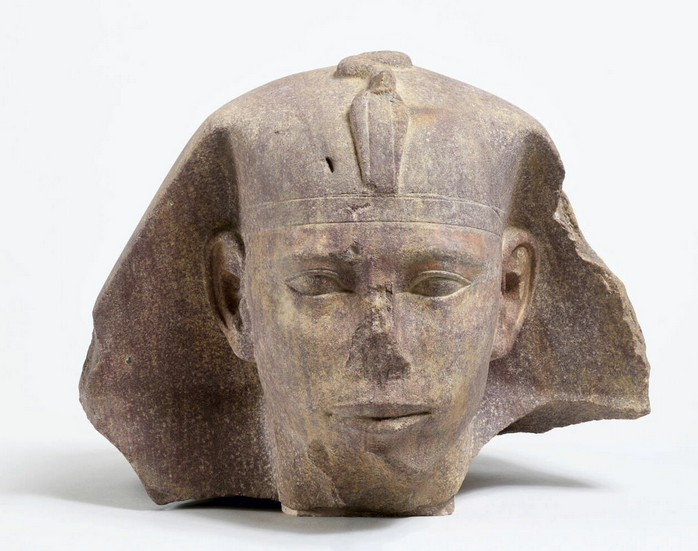
Djedefre is depicted seated or standing (based on fragmentary evidence), wearing royal regalia. His face is more individualized than his predecessors, and some depictions suggest he may have worn a solar crown or symbols associating him directly with the sun god.
Artistic Style
The statue exhibits more naturalistic facial modeling and softer features compared to the rigid power of Khufu's art. It represents a new artistic direction characterized by high-quality craftsmanship and greater experimentation in form.
Facial Features
Surviving fragments, such as the famous head in the Louvre, show rounded cheeks, a slight smile, and a distinct chin. The expression is less rigid than earlier Old Kingdom statues, indicating a move toward greater realism and humanity.
Material: Quartzite
Djedefre often used Quartzite, an extremely hard stone associated with the sun due to its reddish color. This material choice symbolized durability, power, and eternity, reinforcing his connection to the solar deity.
Religious Meaning
In Egyptian belief, the king was a manifestation of the sun god. Statues allowed this divine presence to remain on earth. Djedefre's reign marks the point where the royal cult began to merge significantly with the solar cult of Heliopolis.
Funerary Beliefs
Djedefre’s statues reflect a solar afterlife. Instead of a purely stellar or Osirian destiny, the emphasis shifted to the king’s union with Ra. The king was expected to join the solar barque and undergo daily rebirth with the sun.
Artistic Innovation
Compared to earlier kings, Djedefre's art shows more expressive faces and the use of harder, more colorful stones like quartzite. It demonstrates a preference for innovation over strict tradition, setting a precedent for later dynasties.
Condition
Most surviving pieces are fragmentary. Some heads and torsos have been identified and are scattered across museums like the Louvre. These fragments have been reconstructed through scholarship to give us a glimpse of the original masterpieces.
Archaeological Significance
The statue helps scholars understand the origins of solar kingship and the evolution of royal titles. It provides evidence for the ideological changes that occurred during the Fourth Dynasty, solving key historical puzzles about the shift in religious focus.
Comparison: Evolution of Ideology
| King | Primary Ideology | Key Feature |
|---|---|---|
| Khufu (Father) | Monumental Power | Great Pyramid |
| Djedefre | Solar Divinity | Title "Son of Ra" |
| Khafre (Brother) | Divine Perfection | Sphinx & Standardized Art |
A clear progression from earthly might to solar divinity.
Educational Value
This statue is used to teach the development of royal theology, the influence of the solar cult, and the nuances of early portraiture. It is critical for understanding how the concept of kingship evolved in the Old Kingdom.
Simplified Summary
The Statue of Djedefre represents the moment when the pharaoh becomes the visible son of the sun god. It marks a turning point in Egyptian royal art, where power is defined not just by size, but by a direct connection to the heavens.