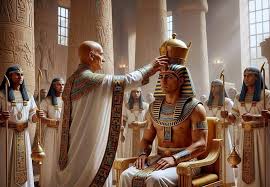
"I am the pure one, who comes forth from the purification... I am the servant of the god who enters the Holy of Holies."
In Ancient Egypt, there was no separation between "church" and "state." The temples were the economic engines of the nation, and the priesthood was a professional class that managed the gods' houses. High Priests controlled vast wealth, thousands of acres of farmland, and fleets of ships, making them rival the power of the Pharaoh himself.
The Temple Hierarchy
The priesthood was strictly hierarchical, resembling a government ministry more than a modern clergy.
1. The High Priest (Hem-Netjer-Tepy)
The "First Servant of the God." He acted as the Pharaoh's deputy in the temple. At Karnak, the High Priest of Amun was one of the most powerful men in Egypt, controlling the temple's vast treasury and political influence.
2. The Waab Priests (The Pure Ones)
The lower clergy who performed the daily tasks: carrying offerings, cleaning the temple, and assisting in rituals. They had to be ritually pure, shaving their entire bodies and bathing in the sacred lake twice a day and twice a night.
3. Specialists
Lector Priests: The scribes who read the magical spells from papyrus scrolls.
Sem Priests: Wore leopard skins and performed funeral rites (Opening of the Mouth).
Astronomers: Watched the stars to determine festival dates and hours of the night.
Feeding the Gods
The primary duty of the priest was not to preach to the people, but to care for the god. The temple statue was believed to house the Ba (soul) of the deity.
Every morning at dawn, the High Priest broke the clay seal of the shrine, saying "The gates of heaven are opened." He would wash the statue, clothe it in fresh linen, anoint it with expensive oils, and offer it food and drink. This maintained Ma'at and ensured the god remained in the temple to protect Egypt.
Part-Time Priests
Unlike modern clergy, most Egyptian priests were not "full-time" religious figures. They were often civil servants, doctors, or administrators who served in the temple on a rotation system.
The Phyle System: Priests were divided into four groups (phyles). Each group served for one month, then returned to secular life for three months. This integrated the temple deeply into the daily life of the community.
The Voice of God
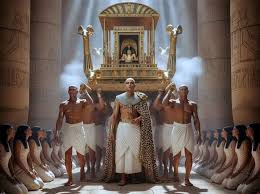
Priests interpreted the divine will through Oracles. During festivals, the god's statue was carried in a barque. If the heavy boat "nodded" forward or backward, it was interpreted as a "Yes" or "No" from the god. This gave priests immense power to influence legal disputes, land ownership, and even royal succession.