.jpg)
"His majesty went forth... his infantry and chariotry being with him. They were like lions on the mountains... The hearts of the soldiers were strong, for they knew their King was with them."
In the Old Kingdom, Egypt relied on peasant conscripts. But by the New Kingdom (c. 1550–1070 BCE), the threat of foreign invasion necessitated a revolution. Egypt developed a professional standing army. Being a soldier was no longer a temporary burden; it became a respected career, a distinct social class, and one of the few ways a commoner could rise to nobility.
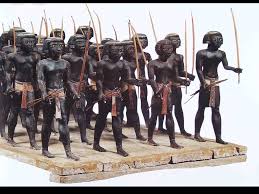
The Structure of the Army
The military was highly organized, divided into two main branches:
The Infantry (Meshw)
The backbone of the army. Armed with spears, shields, axes, and the khopesh sword. They were organized into companies of 200 men, each with its own standard and battle cry.
The Chariotry (Seneny)
The elite strike force. Charioteers were often drawn from the upper classes or successful soldiers. They drove light, two-man vehicles and acted as mobile archery platforms.
Social Mobility: The Gold of Valor
For a peasant boy, the army offered a way out of poverty.
- The Gold of Valor: Soldiers who distinguished themselves in battle (e.g., by capturing prisoners or hands) were publicly rewarded by the Pharaoh with the "Gold of Valor"—heavy gold fly-shaped pendants.
- Spoils of War: Soldiers were allowed to keep a portion of the plunder (cattle, goods, and slaves) taken from conquered cities.
- Land Grants: Upon retirement, veterans were often given plots of tax-free land and servants, effectively elevating them into the land-owning class.
From Soldier to Pharaoh
The military became so powerful that it eventually produced kings. By the end of the 18th Dynasty, the line between general and Pharaoh blurred.
Horemheb, a general under Tutankhamun, became Pharaoh and stabilized the country. The Ramesside kings (19th and 20th Dynasties) were all descended from a family of military commanders, reshaping Egyptian culture into a martial society that glorified war and conquest.