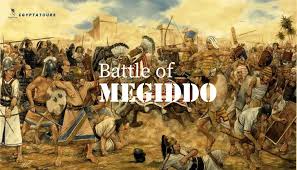
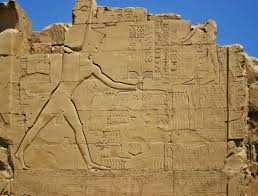
"I captured the enemy of Megiddo in a moment... My majesty attacked them, and they fled head over heels in terror to Megiddo, abandoning their horses and their chariots of gold and silver." – The Annals of Thutmose III at Karnak.
Thutmose III (ruled c. 1479–1425 BCE) is widely regarded as the greatest military genius of Ancient Egypt. Often called the "Napoleon of Egypt" by modern historians, he conducted 17 military campaigns in 20 years and never lost a battle. He transformed Egypt from a kingdom into a true superpower, stretching its borders from the Fourth Cataract of the Nile in the south to the banks of the Euphrates River in the north.
The Battle of Megiddo (c. 1457 BCE)
Shortly after the death of his stepmother and co-regent, Hatshepsut, a massive coalition of Canaanite and Syrian princes led by the King of Kadesh revolted against Egyptian rule. They gathered their forces at the fortress city of Megiddo (modern-day northern Israel).
The Aruna Pass Gamble
Thutmose III marched his army to the Carmel Ridge. His generals advised him to take one of two wide, safe roads around the mountains. Thutmose refused. He chose the Aruna Pass—a narrow, dangerous ravine where the army would have to march single file, horse behind horse.
His reasoning? The enemy would never expect him to be so foolish. He was right. The rebels guarded the easy roads, leaving the Aruna Pass undefended. The Egyptian army emerged onto the plain of Megiddo right in the enemy's rear, achieving total tactical surprise.
The Siege and Victory
The initial battle was a rout. The rebel coalition fled in panic behind the walls of Megiddo. However, the Egyptian soldiers stopped to loot the golden chariots left on the battlefield instead of pursuing the enemy, allowing the rebels to close the gates.
This mistake led to a seven-month siege. Thutmose III built a moat and a wooden stockade around the city, starving them out. Finally, the princes surrendered, sending out their children with gifts of gold and pleading for breath. Thutmose spared their lives but took their sons as hostages to Egypt to be raised as loyal Egyptians.
Expanding to the Euphrates
Megiddo was just the beginning. Over the next two decades, Thutmose III launched annual campaigns to subdue the Levant and check the power of the Mitanni Empire.
- Boats on Carts: In his 8th campaign, he famously had ships built in Byblos (Lebanon), loaded onto ox-carts, and hauled 250 miles overland to cross the Euphrates River—a logistical masterpiece.
- The Elephant Hunt: While in Syria, he took time to hunt elephants, recording that he killed 120 of them for their ivory.