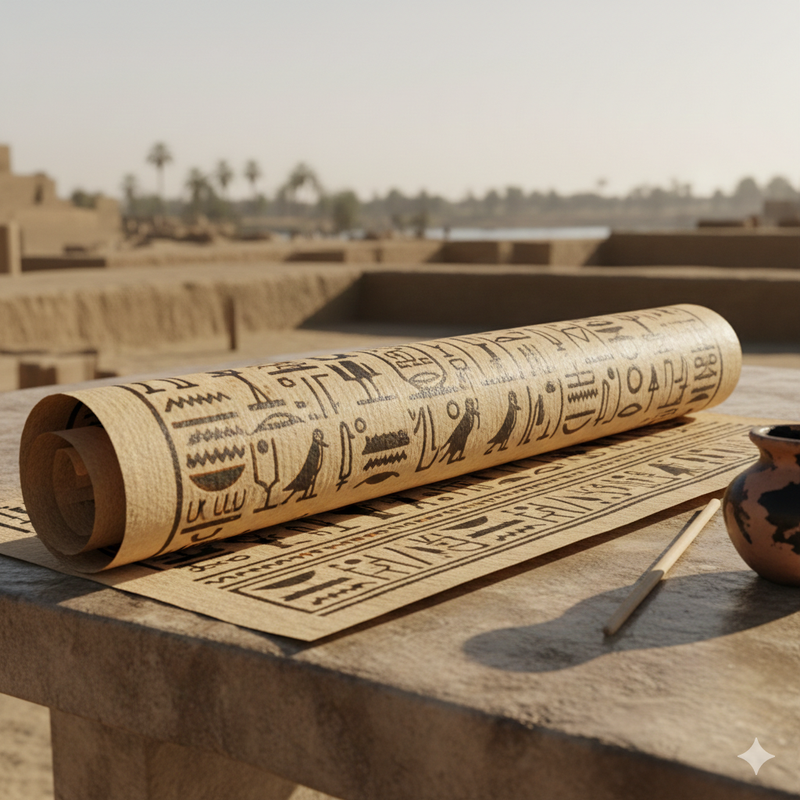
"Hieroglyphs were not just letters; they were art, magic, and the voice of the gods. Understanding them unlocks the true mind of the Ancient Egyptians."
The Ancient Egyptians called their writing Medu Neter (The Words of God). It is a complex system that uses a combination of logograms (signs representing ideas) and phonograms (signs representing sounds). Deciphered by Jean-François Champollion in 1822 via the Rosetta Stone, it remains one of the most fascinating scripts in history.
1. The Uniliteral Signs (The Alphabet)
While there are over 700 hieroglyphic signs, the core "alphabet" consists of 24 (or 25) mono-consonants. These are the most essential signs to learn.
2. Essential Grammar Rules
A. Direction of Writing
Hieroglyphs can be written left-to-right, right-to-left, or top-to-bottom. The key rule: Always read into the faces of the humans or animals. If a bird faces right, you read from right to left.
B. Determinatives
Because Egyptian did not write vowels, many words looked the same (e.g., 'Ra' the sun and 'Ra' the mouth). To solve this, they added a silent sign at the end called a Determinative to give context.
- 𓀀 (Man) - Used for male names/roles.
- 𓁐 (Woman) - Used for female names/roles.
- 𓇳 (Sun) - Used for time or sun-related words.
- 𓀜 (Motion) - Used for verbs of movement (walking, running).
C. Gender & Plural
- Feminine: Nouns ending in 𓏏 (t) are usually feminine.
- Plural: Indicated by three strokes 𓏦 or three dots. It adds a "w" sound (u).
3. Common Vocabulary
These are words you will see frequently on temple walls and tombs.
| Hieroglyphs | Transliteration | Meaning |
|---|---|---|
| 𓋹 | Ankh | Life |
| 𓄤 | Nefer | Good / Beautiful / Perfect |
| 𓊹 | Netjer | God |
| 𓇳 | Ra | Sun / Day |
| 𓎟 | Neb | Lord / All / Master |
| 𓆎𓅓𓏏𓊖 | Kemet | Egypt (The Black Land) |
| 𓉐𓉻 | Per-Aa | Pharaoh (Great House) |
| 𓌸𓂋 | Mer | Love |
4. Famous Phrases & Titles
Ankh Wedja Seneb
Translation: "Life, Prosperity, Health"
This phrase was always written after the name of the Pharaoh to wish him well. Often abbreviated as L.P.H.
Nesu Bity
Translation: "King of Upper and Lower Egypt"
Literally "He of the Sedge and the Bee". This title precedes the king's throne name in a cartouche.
Sa Ra
Translation: "Son of Ra"
This title precedes the king's birth name (e.g., Ramses, Amenhotep).
Hotep Di Nesu
Translation: "An Offering the King Gives"
The standard opening formula for offering prayers found on almost all stelae and tombs, ensuring the deceased receives food in the afterlife.