Introduction: The Mediterranean's Secret
For over a thousand years, they were myths—ghost cities mentioned by Herodotus and Strabo, swallowed by the sea and lost to time. But in the late 20th century, the silence of the deep was broken. Led by underwater archaeologist Franck Goddio, a team discovered two entire cities sleeping beneath the Mediterranean waves: Thonis-Heracleion and Canopus, along with the royal quarters of ancient Alexandria.
Read More →1. Thonis-Heracleion: Egypt's Lost Port
Before Alexandria was founded, Thonis-Heracleion was the obligatory port of entry for all Greek ships coming into Egypt. It was a thriving cosmopolitan hub of trade and religion.
The Temple of Amun-Gereb
At the city's heart stood a massive temple to Amun-Gereb. Here, new Pharaohs came to receive the divine title to rule. The discovery of the Stele of Thonis-Heracleion (a twin to the Decree of Naucratis) was crucial, as it confirmed the city's name and its pivotal role in taxation and maritime law.
The Mysteries of Osiris
Underwater excavations revealed long ceremonial barges and ritual vessels used in the "Mysteries of Osiris." Every year, a procession would carry a statue of Osiris by boat from the temple in Heracleion to his shrine in Canopus, celebrating his resurrection.
2. Alexandria's Royal Quarter (Portus Magnus)
In the Eastern Harbor of modern Alexandria lies the submerged royal district of the Ptolemies. This was the stage for the drama of Cleopatra, Julius Caesar, and Mark Antony.
Antirhodos Island & Cleopatra's Palace
Archaeologists have mapped the sunken island of Antirhodos, finding the foundations of a modest but elegant palace believed to be Cleopatra's. Nearby, a small temple to Isis and a granite sphinx bearing the face of her father, Ptolemy XII, were found preserved in the sediment.
The Timonium
Also discovered are the remains of the **Timonium**, a retreat built by Mark Antony after his defeat at Actium, where he intended to live in solitude before his final days.
Dive into the Palace →3. Canopus: The City of Pleasure and Piety
Located a few miles east of Heracleion, **Canopus** was famous in antiquity for two things: its wild, hedonistic lifestyle and its miraculous Temple of Serapis. It was a city of resorts, canals, and festivals, where pilgrims came for healing and pleasure. The ruins of the Serapis temple have been identified, along with evidence of the lavish lifestyle that scandalized Roman moralists.
4. The Treasures of the Deep
The sea floor has yielded thousands of artifacts that are rewriting history. Because they were buried in sediment, they are often in better condition than those found on land.
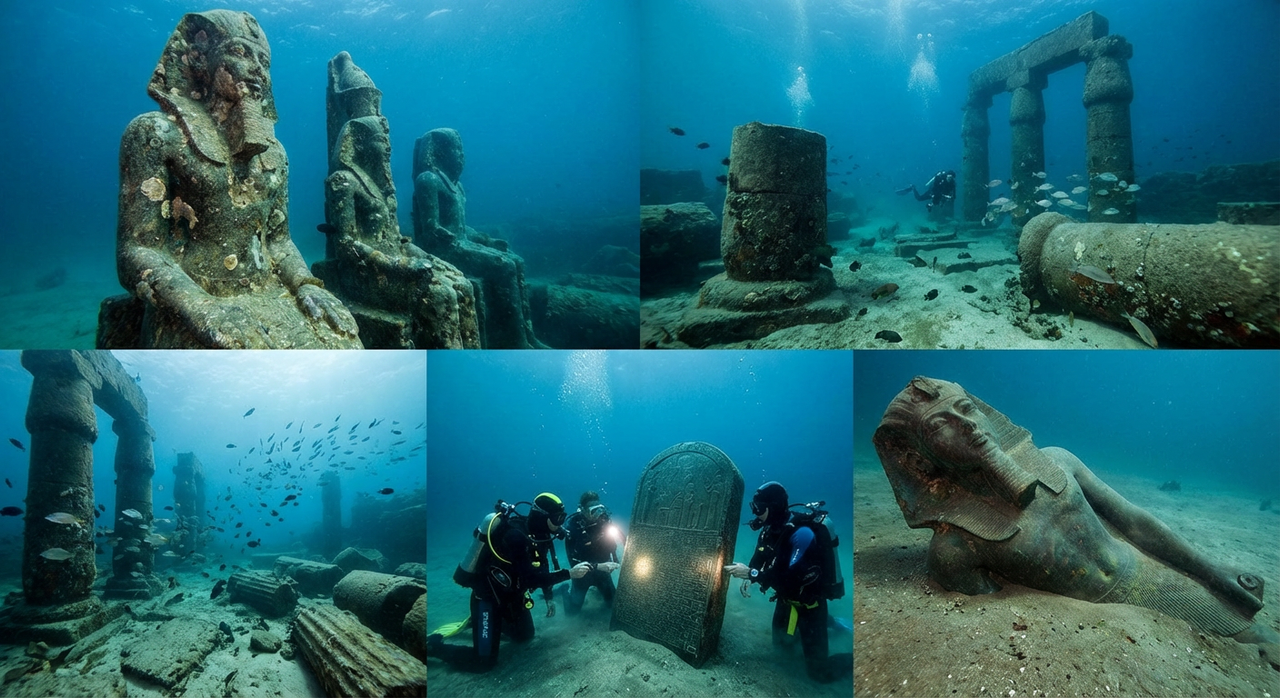
The 5.4-meter tall red granite statue of Hapi, god of the Nile flood, recovered from Heracleion.
| Artifact | Significance |
|---|---|
| Colossal Hapi | Largest known statue of the Nile god, symbolizing abundance. |
| Gold Coins | Byzantine and Islamic coins proving the city remained active until the 8th century. |
| Ritual Ladles | Bronze ladles used in temple ceremonies, found in pristine condition. |
| Shipwrecks | Over 70 ancient ships found in the harbor, the largest naval collection from antiquity. |
5. The Catastrophe: Liquefaction
Why did these great cities vanish? The answer lies in geology. The cities were built on the unstable clay sediments of the Nile Delta. A series of earthquakes and tidal waves triggered a phenomenon called **soil liquefaction**. The solid ground turned to liquid, and the heavy temples and palaces simply sank into the mud, eventually being covered by the rising Mediterranean sea level.
6. The Technology of Discovery
Finding these cities required cutting-edge technology. Franck Goddio's team used **Nuclear Magnetic Resonance (NMR)** magnetometers to detect minute anomalies in the Earth's magnetic field caused by buried stone structures. This allowed them to map the entire city of Heracleion before a single diver touched the water.
Conclusion: History Resurfaced
The sunken cities of Egypt are a time capsule. Unlike sites on land that have been built over or looted, Heracleion and the Royal Quarter remain exactly as they were the day they sank. They remind us of the fragility of civilization against the power of nature, and the enduring allure of Egypt's secrets.