1. Introduction
The Catacombs of Kom El Shoqafa (Arabic: Kum al-Shaqafah, meaning "Mound of Shards") represent one of the most fascinating archaeological sites in Alexandria. Dating back to the 2nd century AD, this necropolis is a rare and striking example of the cultural melting pot that was Alexandria, where Pharaonic, Greek, and Roman traditions blended seamlessly into a unique artistic style known as the "Alexandrian Style."
Originally dug for a single wealthy family, the complex eventually expanded to become a mass burial site, housing over 300 mummies. It is considered one of the Seven Wonders of the Middle Ages due to its architectural complexity and depth.
2. The Accidental Discovery: The Donkey's Tale
For centuries, the catacombs lay hidden beneath a mound of earth used as a dumping ground for broken pottery (hence the name). The discovery came on September 28, 1900, through a sheer accident. As local legend and official reports recount, a donkey hauling stone for a nearby quarry suddenly fell through a hole in the ground.
3. Architectural Layout: A Descent into the Underworld
The complex is carved into solid bedrock across three levels, reaching a depth of 35 meters. It is a masterpiece of subterranean engineering.
- The Spiral Staircase: The entry is a massive circular shaft with a spiral staircase running around a central well. The steps were designed with a deeper section on the outside for people and a sloped section on the inside to lower the bodies of the deceased using ropes.
- Level 1 (The Rotunda): At the bottom of the stairs lies the Rotunda, a circular reception hall with a domed ceiling. From here, visitors can access the Triclinium.
- Level 2 (The Principal Tomb): The most important part of the complex, featuring the main burial chamber and the famous reliefs.
- Level 3 (The Flooded Level): The lowest level, likely containing more tombs, is currently inaccessible as it is submerged by the rising water table of Alexandria.
4. The Principal Tomb: Where Anubis Wears a Toga
The central burial chamber on the second level is the jewel of Kom El Shoqafa. It offers the clearest example of the religious syncretism of the time. The artists did not simply place Egyptian and Roman statues side by side; they hybridized them.
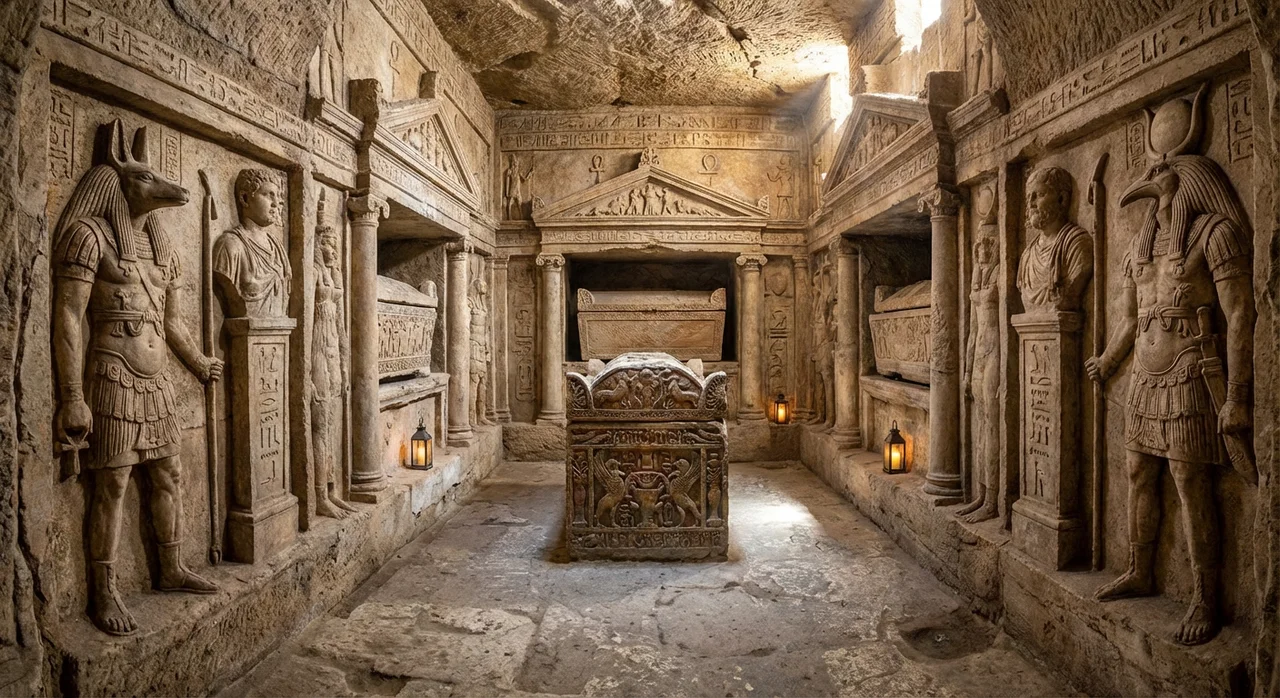
Anubis, the Egyptian god of the dead, depicted wearing Roman military armor.
Key Artistic Elements:
- Anubis the Legionary: Guarding the tomb entrance is the jackal-headed god Anubis. However, instead of a loincloth, he wears the armor of a Roman soldier and holds a Roman shield, yet stands in a rigid Pharaonic pose.
- Sobek-Agathos Daimon: The Egyptian crocodile god Sobek is fused with the Greek Agathos Daimon (Good Spirit). He is depicted as a serpent wearing the double crown of Upper and Lower Egypt, carrying the staff of Hermes (Caduceus) and the thyrsus of Dionysus.
- The Medusa Shields: Above the loculi, round shields featuring the head of Medusa (a Greek protector against evil) are carved to ward off grave robbers, yet they are flanked by Egyptian cobras.
5. The Triclinium (Feast Hall)
To the left of the Rotunda is the Triclinium, a banquet hall with three stone benches carved in a U-shape. This room brings the ancient funerary rites to life. Relatives of the deceased would gather here not just for the funeral, but for regular commemorative feasts (the refrigerium).
They would dine "with" the dead, sharing food and wine. It was the custom to break the terracotta plates and jars after the meal, as objects used in the necropolis could not be taken back to the world of the living. The accumulation of these shards over centuries gave the site its name: Kom El Shoqafa.
6. The Hall of Caracalla: A Grim History
Accessed through a breach in the wall from the first level is a separate burial complex known as the Hall of Caracalla. This area contains the bones of young men and horses.
Historians believe these are the victims of a massacre ordered by the Roman Emperor Caracalla in 215 AD. Angered by a satire performed by the Alexandrians mocking him, Caracalla ordered his troops to slaughter the city's youth. These mass graves serve as a dark reminder of Alexandria's turbulent relationship with its Roman rulers.
7. The Chamber of Nemesis
Another fascinating section is dedicated to Nemesis, the Greek goddess of divine retribution. In this chamber, you can find a statue of the goddess, often associated with sport and competition. It is believed that locals would visit this shrine to offer prayers before competitions or to seek justice, further highlighting the active, living nature of this necropolis in ancient times.
8. Quick Facts
9. Visiting Guide
Location: The catacombs are located in the Karmouz district of western Alexandria.
Accessibility: The spiral staircase is wide but deep. The lowest level is flooded and inaccessible. The site is humid, so lightweight clothing is recommended.
Photography: Photography is generally allowed with mobile phones, but flash is strictly prohibited to preserve the pigments on the painted reliefs.
Nearby Sites: Combine your visit with Pompey's Pillar (Serapeum), which is just a short walk away.