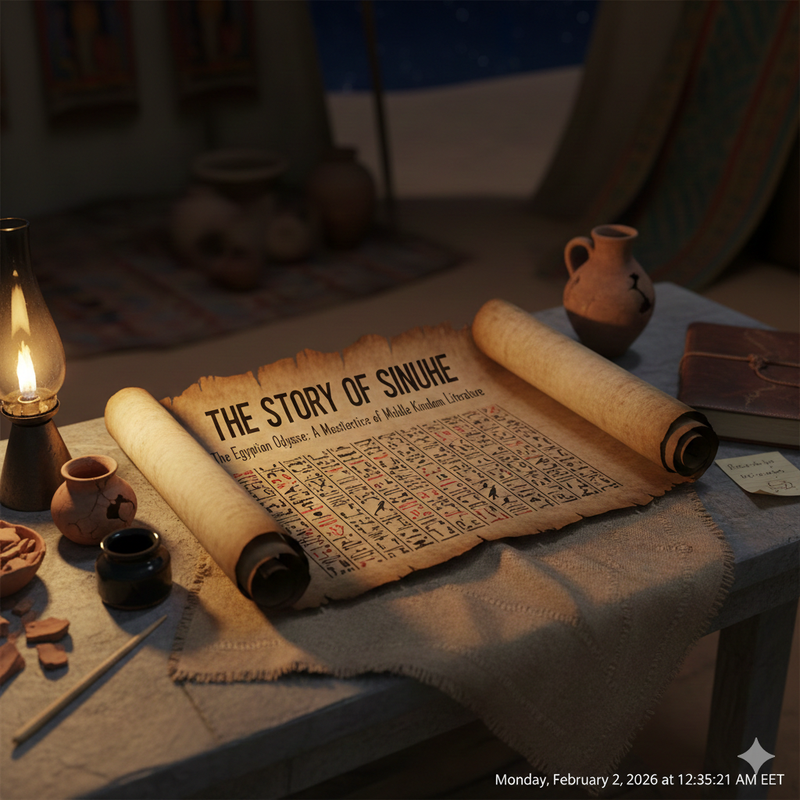
"I was a follower who followed his lord... but when I heard the news of the King's death, my heart began to pound, my arms fell limp, and trembling fell upon all my limbs. I leaped away to seek a hiding place..."
The Story of Sinuhe is widely considered the crowning jewel of Ancient Egyptian literature. Written during the Middle Kingdom (c. 1960 BCE) in the reign of Senusret I, it tells the fictional (or perhaps semi-historical) autobiography of a court official named Sinuhe. It is a story of fear, exile, identity, and the profound Egyptian longing to die on native soil.
The Flight from Egypt
The story begins with a shock. King Amenemhat I has been assassinated (possibly in a harem conspiracy). Sinuhe, a high-ranking assistant, is accompanying the Crown Prince Senusret on a military campaign in Libya when the news arrives.
Terrified that chaos will engulf the court or that he might be implicated, Sinuhe panics. He hides behind a bush while the Prince rushes back to the capital, and then Sinuhe flees—not to the court, but away from it. He crosses the Nile and heads east into the Sinai desert, nearly dying of thirst until he is rescued by Bedouins.
A Prince in a Foreign Land
Sinuhe travels to Retenu (modern-day Syria/Palestine). There, he is welcomed by a local chieftain named Amunenshi. Sinuhe marries the chief's eldest daughter and is given fine land called Yaa, rich in figs, grapes, wine, honey, and olives.
He rises to power, becoming a commander of the army and defending his adopted tribe against neighbors. He lives as an Asiatic for many years, growing wealthy and having children who become chiefs themselves.
The Duel of Retenu
In a famous scene reminiscent of David and Goliath, a mighty champion of Retenu challenges Sinuhe to single combat, jealous of his status. Sinuhe, though older, uses his Egyptian training. He dodges the champion's javelins and arrows, then strikes him down, claiming his cattle and wealth.
The Longing for Home
Despite his success, Sinuhe is haunted by one fear: dying abroad. To an Ancient Egyptian, being buried in foreign sand meant the soul might be lost forever. Only the rites of an Egyptian burial could guarantee eternal life.
"What is more important than that my corpse be buried in the land where I was born? Come to my aid! May a happy end be granted me!"
The Return and Redemption
Pharaoh Senusret I hears of Sinuhe's plight and sends a royal decree inviting him back, pardoning his flight, and promising a tomb near the royal pyramid. Sinuhe is overjoyed.
Upon his return to the palace, Sinuhe throws himself on the ground before the King. The royal children do not recognize him in his Asiatic beard and colorful wool clothes. The King orders him to be cleansed. Sinuhe shaves his beard, dresses in fine linen, and is anointed with precious oils. He is given a house, a garden, and a pyramid tomb built while he is still alive. The story ends with his death in old age, favored by the King.