
"Paris is not a city; it is a world." – King Francis I.
From the storms of the French Revolution to the serene halls of the Louvre, Paris has been the forge of modern democracy and the guardian of ancient history. It is a city where an Egyptian obelisk stands at the center of its most famous square, symbolizing a timeless bond between the Nile and the Seine.
Paris, the capital of France, has been a leading global city for art, fashion, gastronomy, and culture since the 17th century. Its history of political revolution—specifically the Revolution of 1789—reshaped the modern world, championing the ideals of "Liberty, Equality, Fraternity."
The Egyptian Connection: Napoleon & Champollion
The modern world's fascination with Ancient Egypt (Egyptomania) largely began in Paris.
Napoleon's Expedition (1798)
When Napoleon Bonaparte invaded Egypt, he brought 160 savants (scholars) with him. Their work culminated in the monumental Description de l'Égypte, a series of publications that detailed the geography, natural history, and monuments of ancient and modern Egypt, founding the field of modern Egyptology.
Jean-François Champollion
In 1822, in Paris, Champollion famously cracked the code of the Rosetta Stone, finally allowing the world to read hieroglyphs. He became the first curator of the Egyptian collection at the Louvre, ensuring Paris would forever be a center for studying Pharaonic history.
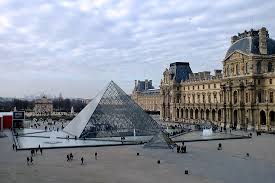
The Louvre: A Palace of Arts
Originally a fortress built in the late 12th century, the Louvre was converted into a royal palace and eventually opened as a museum in 1793 during the French Revolution. It is home to the **Department of Egyptian Antiquities**, one of the largest and most significant collections in the world, comprising over 50,000 objects.
Masterpieces of the Egyptian Department
-
The Seated Scribe: A painted limestone statue from the Old Kingdom (Saqqara), famous for its startling realism and the intelligence visible in the eyes (made of crystal and magnesite).
-
The Great Sphinx of Tanis: One of the largest sphinxes outside of Egypt, carved from pink granite. It dates back to the Old Kingdom but was usurped by later kings like Ramses II.
-
The Zodiac of Dendera: A famous bas-relief from the ceiling of the Osiris chapel in the Temple of Dendera, representing the night sky and the constellations.
The Luxor Obelisk: An Engineering Marvel
In the center of the Place de la Concorde stands the oldest monument in Paris: the Luxor Obelisk. This 3,300-year-old pink granite monolith originally stood at the entrance of the Luxor Temple.
- The Gift: It was a diplomatic gift from Muhammad Ali Pasha, the ruler of Egypt, to King Louis Philippe in 1833. In return, France gifted Egypt a clock tower (which now stands at the Cairo Citadel).
- The Journey (1831-1836): Transporting the 250-ton monolith was a Herculean task. A custom ship, the Luxor, was built to navigate the Nile and the ocean. It took nearly three years to reach Paris and another three years to erect it using a complex system of pulleys and capstans, witnessed by 200,000 cheering Parisians.
- The Gold Cap: In 1998, the French government added a gold-leafed pyramidion to the top of the obelisk, restoring its original ancient appearance.
Architecture: Haussmann and Cairo
The Paris we see today—with its wide boulevards and uniform limestone buildings—is the result of the massive renovation by Baron Haussmann in the 19th century.
This style deeply influenced Khedive Ismail of Egypt. After visiting the Exposition Universelle in Paris in 1867, he was determined to transform Cairo into "Paris on the Nile." He hired French landscape architects and planners to design Downtown Cairo (Khedivial Cairo), resulting in the distinct European-style squares and buildings seen near Tahrir Square today.