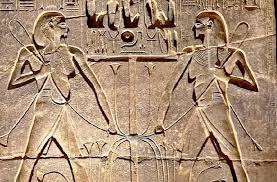
"The Nile was not just water; it was the bloodstream of the gods. Its rising was the resurrection of Osiris, its flow defined the path of the sun, and its banks were the holy ground where temples rose to touch the sky."
To the Ancient Egyptians, the Nile was a manifestation of divine will. They did not call it "the Nile" (a Greek word), but simply Iteru ("The River"). It was the source of all existence, mirroring the celestial river in the sky (the Milky Way) and serving as the primary stage for their most important religious dramas.
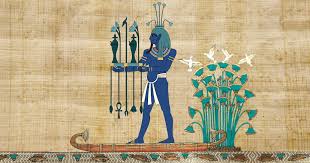
Hapi: The Bringer of Life
The river itself was personified as the god Hapi. He was depicted as an intersex figure with a prominent belly and pendulous breasts, symbolizing the fertility of the Nile mud. His skin was blue or green, representing the water.
Hapi lived in a cavern at the First Cataract (Aswan). Every year, he would pour water from his jars to flood the land, bringing the "Arrival of Hapi." Egyptians sang hymns to him, acknowledging that without his blessing, the temples would be empty and the people would starve.
Osiris: The Dying and Rising River
The cycle of the Nile—flood, receding water, and drought—was inextricably linked to the myth of Osiris.
- The Flood: The annual inundation was believed to be the bodily fluids (sometimes tears) of Osiris, issuing from the underworld to fertilize the land (Isis).
- The Drought: The low water season represented the death of Osiris at the hands of Seth (the desert).
- The Growth: The sprouting of crops from the black mud symbolized the resurrection of Osiris, proving that life conquers death.
Sacred Geography: Aligning with the Divine
The river dictated the layout of the sacred landscape.
East Bank (Life)
The land of the rising sun. Here, the great temples of the gods (Karnak, Luxor) and the cities of the living were built.
West Bank (Death)
The land of the setting sun. This was the realm of the dead, home to pyramids, mortuary temples, and the Valley of the Kings.
Festivals on the Water
The Nile was the stage for the great religious festivals. During the Opet Festival, the statues of Amun, Mut, and Khonsu traveled from Karnak to Luxor Temple in golden barques (boats) carried on the river. The populace lined the banks, singing and dancing as the gods sailed by, reinforcing the bond between the river, the gods, and the people.