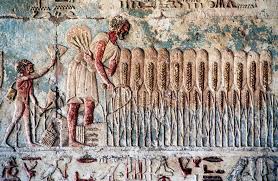
"The wealth of Egypt was not gold, but grain. The predictability of the Nile flood allowed the Pharaohs to plan years in advance, creating the most stable economy in the ancient world."
In a world where drought meant the collapse of civilizations, Egypt stood firm. The secret to its remarkable 3,000-year stability was the predictability of the Nile. Unlike the erratic Tigris and Euphrates in Mesopotamia, the Nile flooded at the same time every year. This reliability allowed the state to plan harvests, store surpluses, and build a sophisticated economy without the use of coined money.
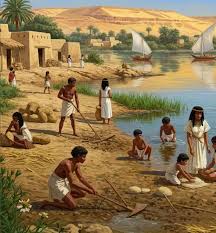
Grain: The Gold of the People
Ancient Egypt operated on a barter system, but it was highly sophisticated. The standard unit of value was the Khar (a sack of grain, roughly 76 liters) and the Deben (a weight of copper, roughly 91 grams).
- Salaries: Workers at Deir el-Medina (who built the royal tombs) were paid monthly in sacks of wheat (for bread) and barley (for beer). A foreman might earn 7.5 sacks a month, while a laborer earned 5.5.
- Taxation: There was no income tax in money. Farmers paid a portion of their harvest to the state. This grain was stored in massive temple granaries and redistributed to feed priests, soldiers, and state workers.
The River of Commerce
The Nile was the artery of trade. Transporting goods by land was slow and expensive. The river allowed heavy loads to be moved cheaply over vast distances.
Internal Trade
Granite from Aswan, limestone from Tura, and gold from Nubia were all floated downstream on barges. Grain from the Delta moved upstream to feed the south.
International Trade
Ports in the Delta connected Egypt to the Mediterranean. Egypt exported grain, papyrus, and linen, and imported timber (cedar) from Lebanon, olive oil, and silver.
Planning Against Famine
The Biblical story of Joseph storing grain for seven lean years reflects a historical reality. The Egyptian state was obsessed with storage.
The Granaries: Massive mudbrick storehouses (like those found at the Ramesseum) could hold tons of grain. In years of low floods, the state opened these reserves to prevent famine, ensuring social stability. This centralized control over food was the source of the Pharaoh's absolute power.