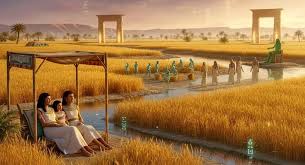
"I have entered the Field of Offerings... I have come to the region of the Horizon-dwellers. I ferry across in the boat... I plough and I reap." – Book of the Dead, Spell 110.
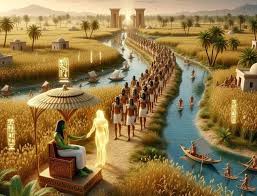
The Ancient Egyptians loved their land so much that they could not imagine a heaven without it. Their vision of eternity, the Field of Reeds (Aaru), was not a vague cloud city but a perfected, mirror image of the Nile Valley. It was a land of eternal harvests, endless water, and familiar comforts, where the Nile flowed forever without drought or destruction.
A Mirror of Earth
In the afterlife, the geography mimicked the physical Nile. The deceased were expected to cultivate crops in lush fields irrigated by celestial canals.
- Eternal Harvests: Wheat grew taller than a man, and the fruit was always ripe.
- Shabti Workers: To avoid the hard labor of farming in paradise, the wealthy were buried with magical servant statues (Shabtis) to do the work for them.
The Celestial River
The Egyptians looked up at the night sky and saw the Milky Way as a "Celestial Nile" (Winding Waterway). This was the path the sun god Ra sailed during the day.
The underworld (Duat) also had a river—a dark, dangerous counterpart to the Nile—which Ra navigated at night, battling chaos to be reborn at dawn. The soul's journey was essentially a voyage by boat across these cosmic waters.
Crossing the Waters
Just as one needed a boat to cross from the East Bank to the West Bank in life, the soul needed a boat to reach the afterlife.
The Ferryman
To cross the "Lily Lake" or the "Winding Waterway" to reach paradise, the deceased had to persuade a grumpy, backward-facing ferryman named Mahaf ("He who looks behind him"). The soul had to prove its worthiness and knowledge of magic to gain passage on his boat.