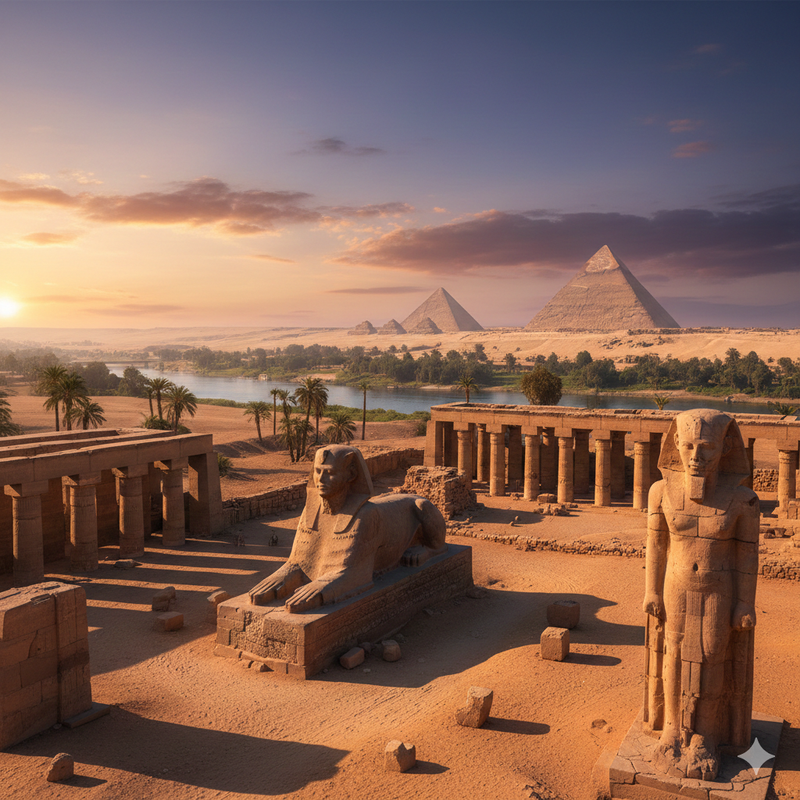
"Known as 'Ineb-Hedj' or 'The White Walls,' Memphis was the administrative and religious heart of Egypt for centuries. It was here that Pharaohs were crowned, and the god Ptah crafted the world."
Founded around 3100 BCE by the legendary King Menes (Narmer), Memphis was the first unified capital of Ancient Egypt. Located at the apex of the Nile Delta, it served as a strategic bridge between Upper and Lower Egypt. As the religious center dedicated to Ptah, the creator god and patron of craftsmen, it controlled the Nile trade routes for millennia.
The Balance of Two Lands
Memphis was not chosen by accident. Its location (near modern-day Mit Rahina, south of Cairo) allowed the Pharaohs to effectively govern both the agricultural Delta in the north and the Nile Valley in the south.
- The Name: Originally called Ineb-Hedj (The White Walls), likely referring to the king's fortified palace. The name "Memphis" is a Greek corruption of the name of Pepi I's pyramid city, Men-nefer (Established and Beautiful).
- The Center of Power: For the entire Old Kingdom (Age of Pyramids), the ruling dynasties resided here. Even when the capital moved to Thebes in the New Kingdom, Memphis remained the second capital, the primary military headquarters, and the gateway to the Mediterranean.
The Memphite Theology & The Triad
At the heart of the city stood the Great Temple of Ptah (Hout-ka-Ptah), one of the largest and most influential religious complexes in antiquity. The priests of Memphis developed a sophisticated creation myth known as the "Memphite Theology."
The Creator God: Ptah
Unlike Atum of Heliopolis who created via physical means, Ptah created the universe through intellect and speech. He conceived the world in his heart (thought) and spoke it into existence with his tongue. He was the supreme patron of craftsmen, architects, and builders.
The Memphite Triad
Like most major Egyptian cities, Memphis worshiped a holy family triad:
Ptah (The Father)
The creator god, depicted as a mummified man wearing a skullcap and holding a scepter combining life (Ankh), stability (Djed), and power (Was).
Sekhmet (The Mother)
The fierce lioness goddess of war, fire, and healing. She represented the destructive heat of the sun but also protected the Pharaoh in battle.
Nefertem (The Son)
Associated with the primeval lotus flower that rose from the waters of creation. He was the god of perfume, beauty, and healing.
The Necropolis of Memphis
A capital city requires a place for its kings to rest for eternity. The necropolis of Memphis is not a single site, but a vast stretch of desert plateau extending over 30 kilometers along the Nile. This area includes the most famous pyramid fields in Egypt.
- Saqqara: The principal cemetery of Memphis, serving the city for over 3,000 years. It houses the Step Pyramid of Djoser (the first stone building in history) and the Serapeum (burial place of the Apis Bulls).
- Giza: The burial ground for the 4th Dynasty kings, famous for the Great Pyramids and the Sphinx.
- Abusir & Dahshur: Home to the pyramids of the 5th Dynasty and the innovative Bent and Red Pyramids of Sneferu.
In 1979, UNESCO designated the ruins of Memphis and its necropolis (from Giza to Dahshur) as a World Heritage Site.
Visiting Memphis Today (Mit Rahina)
The ancient city itself lies mostly beneath the modern village of Mit Rahina and lush palm groves. Much of its stone was dismantled over centuries to build Cairo. However, the Open-Air Museum at Memphis preserves colossal statues that hint at its former glory.
Key Sights in the Open-Air Museum
-
Colossus of Ramses II: A massive limestone statue of Ramses the Great, originally over 10 meters tall. Though lying on its back (its feet are broken off), the detail in the face, muscles, and royal insignia is exquisite. It is housed in a dedicated viewing pavilion.
-
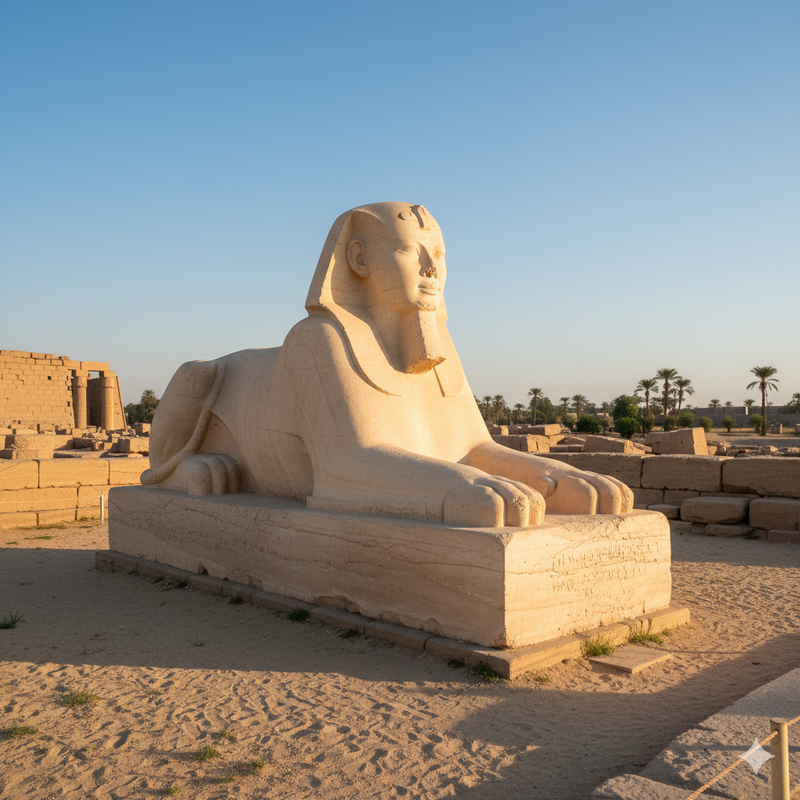
The Alabaster Sphinx: The largest calcite statue ever found, weighing 80 tons and standing 8 meters long. Unlike the Great Sphinx of Giza, this one lies in the heart of the city ruins and likely dates to the New Kingdom (Amenhotep II or Hatshepsut).
-
Granite Coffins & Stelae: The garden is filled with granite sarcophagi and stelae depicting various gods, remnants of the once-massive Temple of Ptah.