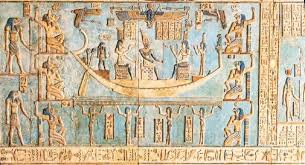
"In the beginning, only the King could climb the stairway to the stars. By the end, every man and woman who lived in Ma'at became an Osiris, finding their own place in the Field of Reeds."
One of the most profound social and religious shifts in Ancient Egyptian history is known as the Democratization of the Afterlife. It refers to the gradual process by which the hope for eternal life expanded from the exclusive privilege of the Pharaoh to include nobles, and eventually, the common people.
The Old Kingdom: Only the King Ascends
During the Pyramid Age (Old Kingdom, c. 2600 BC), the afterlife was an exclusive royal prerogative.
- The Divine King: The Pharaoh was considered a living god, the son of Ra. Only he possessed the divine nature required to ascend to the sky and join the "Indestructible Stars."
- The Nobles' Hope: High officials and family members were buried in mastabas around the king's pyramid. Their hope for an afterlife depended entirely on the king's mercy and their proximity to him. They did not become gods; they remained servants in the next world.
The Crisis of Faith
When the Old Kingdom collapsed (c. 2181 BC), Egypt entered a period of chaos. The central authority of the Pharaoh crumbled. Local governors and warlords took power.
This political fragmentation led to a spiritual revolution. People began to ask: "If the god-king can fail, who can guarantee our eternity?" The answer was that individuals had to secure their own salvation.
The Coffin Texts: Opening the Gates
In the Middle Kingdom, the spells that were once carved on royal pyramid walls (Pyramid Texts) were copied onto the wooden coffins of wealthy commoners. These are known as the Coffin Texts.
Becoming Osiris
Previously, only the dead king was identified with Osiris. Now, every deceased person—regardless of rank—was referred to as "The Osiris [Name]." This meant that everyone had the potential to resurrect, provided they could afford a coffin and the proper rituals.
The New Kingdom: Judgment by Ma'at
By the New Kingdom (c. 1550 BC), the transformation was complete with the Book of the Dead.
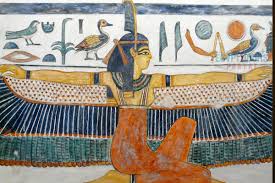
Merit over Birth: The criterion for entering paradise shifted from status (being a king) to morality (Ma'at). In the Hall of Judgment, a peasant's heart was weighed on the same scales as a king's. If the peasant lived a righteous life and the king did not, the peasant would enter paradise while the king faced oblivion.
This moral framework bound the entire society together, giving every individual a stake in the cosmic order.