
Among the thousands of gods that populated the ancient Egyptian pantheon, few captured the imagination of their worshippers — or of the modern world — as powerfully as Anubis. With his jet-black jackal head and watchful golden eyes, he stood at the boundary between the living and the dead, a solemn guardian who neither judged with malice nor welcomed with warmth, but simply ensured that the sacred order of the universe was maintained. For more than three thousand years, his image appeared on tomb walls, canopic jars, funerary papyri, and amulets across Egypt, from the Delta to Nubia.
Anubis was not merely a symbol of death — he was its caretaker. He oversaw the meticulous process of mummification, guided the souls of the deceased through the perilous Duat (the underworld), and presided over the most solemn moment of an Egyptian's spiritual journey: the Weighing of the Heart. Understanding Anubis means understanding how ancient Egyptians perceived mortality, justice, and the eternal promise of life after death.
In This Guide
Who Was Anubis?
Anubis — known in ancient Egyptian as Anpu or Inpu — was one of the oldest and most revered deities of the Egyptian religious tradition. He was the god of embalming, the protector of tombs, and the divine guide who escorted the souls of the dead through the treacherous terrain of the Duat to the Hall of Two Truths, where their hearts would be weighed against the feather of Ma'at, the goddess of cosmic order and justice. In art, he was always depicted as a black canine — either fully as a jackal or as a man bearing a jackal's head — with a sleek, powerful body and alert, upright ears.
The black color of his form was not merely a nod to the jackal's natural coat; it was deeply symbolic. In Egyptian thought, black was the color of the rich Nile silt that brought fertility and rebirth to the land each year after the flood — it was the color of regeneration, of the fertile soil in which the seeds of new life were sown. By being depicted as black, Anubis embodied both death and the promise of resurrection, a bridge between the world of the living and the eternal realm beyond.
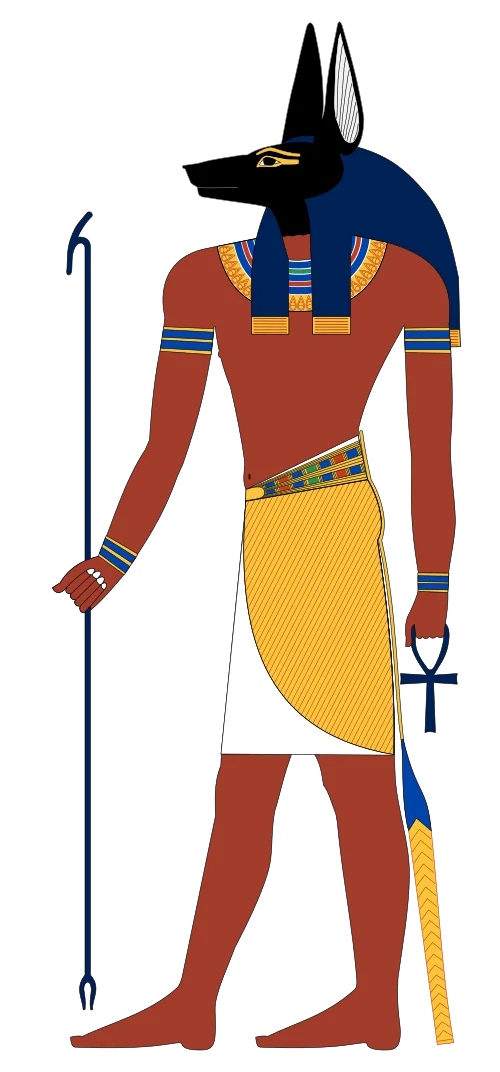
Classic depiction of Anubis holding the was-scepter and ankh — symbols of power and life. His black coloring symbolized regeneration and rebirth in ancient Egyptian thought.
Origins & Mythology
The origins of Anubis stretch back to the very earliest periods of Egyptian civilization. He predates many of the more famous gods of the classical Egyptian pantheon, with evidence of his worship found as far back as the First Dynasty (c. 3100 BCE). Initially, he was the most important funerary deity in all of Egypt — even more prominent than Osiris — before the Osirian cult rose to prominence during the Middle Kingdom and gradually absorbed many of Anubis's functions.
The earliest known depictions of Anubis appear on tomb walls and funerary objects in Predynastic and Early Dynastic Egypt. At this stage, he is already firmly associated with the dead and with mummification.
Anubis reigns as the supreme god of the dead. He is the primary funerary deity, mentioned throughout the Pyramid Texts — the oldest religious corpus in the world — as the guardian of necropolis and protector of royal burials.
The cult of Osiris rises dramatically in power and popularity. Osiris absorbs the role of ruler of the dead, while Anubis is repositioned as the god of the embalming process itself and the divine escort of souls. The two deities become deeply intertwined in funerary theology.
Anubis reaches the height of his popular veneration. The Book of the Dead, widely used in this period, features Anubis in his most iconic role: weighing the heart of the deceased on the scales of justice against the feather of Ma'at. His image appears on countless tomb murals across the Valley of the Kings.
Under the Greek Ptolemaic rulers of Egypt, Anubis is syncretized with the Greek god Hermes — the divine messenger and psychopomp (guide of souls) — to form the hybrid deity Hermanubis. He is depicted with a human body, a jackal head or both, and becomes popular in Greco-Roman religious syncretism across the Mediterranean world.
Worship of Anubis continues and even spreads throughout the Roman Empire, with temples dedicated to him found as far afield as Rome and Britain. The emperor Hadrian is said to have been fascinated by Egyptian religion. Anubis worship gradually fades with the Christianization of the Roman Empire and the official closure of Egyptian temples in 391 CE.
According to the most prevalent mythological tradition, Anubis was born of Osiris, the god of the afterlife and resurrection, and Nephthys, the goddess of death and darkness — though some earlier sources name Ra or Set as his father. Nephthys, who was married to Set but secretly loved Osiris, conceived Anubis and, fearing her husband's wrath, abandoned the infant. Isis, the devoted wife of Osiris, discovered the child and raised him as her own. This origin story positioned Anubis as an insider to the tragedy of Osiris's death, making it natural that he would become the deity most dedicated to preserving the bodies of the dead and ensuring their rebirth.
Iconography & Symbols
The visual language surrounding Anubis is one of the most instantly recognizable in all of ancient art. His depictions were consistent across millennia, evolving only subtly, which speaks to the deeply conservative nature of Egyptian religious art and the god's enduring central importance. Whether painted on a papyrus scroll or carved in stone relief, the image of Anubis carried layers of symbolic meaning that every literate Egyptian would have understood at a glance.
The animal most associated with Anubis is the jackal — or more precisely, the African golden wolf (Canis lupaster), which ancient Egyptians called sab. These slender, dark-coated animals were commonly seen prowling the edges of the desert near burial grounds, scavenging at the margins of human habitation. Rather than portraying this as malevolent, the Egyptians elevated the jackal into a divine protector of the dead, transforming a natural scavenger into a sacred guardian. Anubis's most characteristic attributes include the was-scepter (a symbol of power and dominion), the ankh (the key of life), and the flail. He is also depicted holding the scales of justice during the Weighing of the Heart. His skin in pictorial representations is almost always a glossy, deep black — rich with the symbolism of the fertile Nile earth — while his linen kilt and ritual garments are pristine white, signifying purity.
The epithet most commonly applied to Anubis in religious texts is Khenty-Amentiu — "Foremost of the Westerners" — a title that refers to the dead, who were said to dwell in the west (the direction of the setting sun). He was also called Neb-ta-djeser ("Lord of the Sacred Land"), referring to his domain over the necropolis, the desert burial ground beyond the fertile fields of the Nile. Another frequent title is Imy-ut ("He Who is in the Place of Embalming"), highlighting his intimate connection with the mummification workshop.
The Sacred Roles of Anubis
Within the vast and complex hierarchy of Egyptian religion, Anubis occupied a uniquely active role. Unlike many deities who represented abstract forces or cosmic phenomena, Anubis was a god of processes — of the specific, precise, ritually demanding actions that ensured a soul's successful transition from death to eternal life. His functions were many, and each was essential to the funerary theology that underpinned Egyptian civilization.
The Embalmer's Patron
Anubis was the divine patron of the priests of embalming, who wore jackal-headed masks during their work to channel his presence and sanctify the process. The chief embalmer was often referred to as "the priest of Anubis." Mummification was not merely a preservation technique; it was a sacred ritual believed to prepare the body to receive the soul upon its return from the Hall of Judgment. Anubis presided over every step, from the removal of organs to the application of natron salt, the wrapping in linen, and the final anointing.
Guardian of the Necropolis
As Neb-ta-djeser, Anubis was the sacred protector of tombs and burial grounds. The necropolis — the "city of the dead" — was considered his domain, and his image was placed at the entrance of tombs and carved into the walls of burial chambers to warn away grave robbers and malevolent spirits. Numerous amulets depicting Anubis were placed with the mummy to provide supernatural protection through eternity.
🐾 Lord of the Embalming Hall
Anubis was believed to have personally invented the art of mummification, first practicing it on the body of Osiris after Set murdered and dismembered him.
⚖️ Master of the Scales
In the Hall of Two Truths, Anubis operated the scales on which a deceased person's heart was weighed against Ma'at's feather of truth and justice.
🌑 Guide Through the Duat
Anubis served as the psychopomp — the divine guide — who escorted newly deceased souls through the dangers of the underworld to the Hall of Judgment.
🏺 Keeper of Canopic Jars
Anubis was closely associated with the four Sons of Horus who protected the canopic jars containing the embalmed organs of the deceased.
🪄 Inventor of Mummification
Myth credited Anubis with performing the first act of mummification when he prepared the body of Osiris, teaching humanity this sacred technique.
👁️ Protector of the Deceased
Anubis was invoked in funerary prayers and inscribed on coffins to ensure that the body of the deceased remained inviolate and would be ready for resurrection.
Beyond the mummification process itself, Anubis also played a role in protecting the canopic jars — the four alabaster or limestone vessels that held the embalmed internal organs removed during mummification: the lungs, liver, stomach, and intestines. While the four Sons of Horus (Hapy, Duamutef, Imsety, and Qebehsenuef) were the specific guardians of each jar, Anubis watched over all of them as the supreme protector of the embalmed body.
The Role of Anubis in the Osirian Myth
One of the most important narratives involving Anubis is set within the Osirian cycle — the great mythological drama in which the god Osiris is murdered by his jealous brother Set, and eventually resurrected through the devotion of his wife Isis. According to this myth, it was Anubis who gathered the dismembered pieces of Osiris's body, wrapped them in linen, and performed the first act of mummification, thereby restoring the god to a form in which he could rule the afterlife. This myth was foundational to the entire practice of Egyptian mummification: if Anubis had done this for a god, then the same ritual could be performed for any worthy human being, with the promise of the same eternal life.
Sacred Sites, Artifacts & Worship
The veneration of Anubis was expressed through a rich variety of physical forms — temples dedicated to his worship, sacred rituals performed in his name, funerary artifacts invoking his protection, and artistic representations that adorned the walls of tombs across Egypt. Encountering these surviving objects today, in museums around the world or at archaeological sites in Egypt itself, is one of the most powerful ways to understand the depth of devotion that Egyptians extended to their guardian of the dead.
The Anubieion at Saqqara
One of the most important centers of Anubis worship was the Anubieion at Saqqara, the vast necropolis southwest of Cairo where many of ancient Egypt's earliest and most important tombs were built. Discovered by the Egyptologist Walter Bryan Emery in the 1960s and 1970s, the Anubieion was a sacred complex where thousands of mummified dogs and jackals were interred as offerings to the god. This practice of animal mummification was common in the Late Period and reflects the deep piety Egyptians felt toward the gods they worshipped, expressing devotion through the sacrifice and preservation of the animals associated with each deity.
Cynopolis — The City of Dogs
The primary cult center of Anubis was the city known to the ancient Greeks as Cynopolis ("City of Dogs"), located in the seventeenth nome (administrative district) of Upper Egypt, in the area now known as el-Qays in the governorate of Minya. Here, jackals and dogs were venerated as living manifestations of the god, kept in sacred enclosures and given elaborate burials upon their deaths. The city's Egyptian name, Hardai, meant "the city of the divine canine," and it remained an important center of Anubis worship from the Old Kingdom through the Roman period.
The Weighing of the Heart — Egypt's Most Sacred Ceremony
Of all the roles performed by Anubis, none was more cosmically significant than his function as the master of the Weighing of the Heart ceremony, known in Egyptian as Wsjr-mAa.t-xrw. Depicted on hundreds of surviving papyri and tomb walls — most famously in the Papyrus of Ani, now housed in the British Museum — the ceremony took place in the Aaru, the Hall of Two Truths (also known as the Hall of Ma'at). Before an assembly of forty-two divine judges, Anubis would carefully place the deceased's heart on one side of a great golden scale, and the feather of Ma'at — representing truth, justice, and cosmic harmony — on the other. If the heart was pure and light, free of sin and moral corruption, it balanced the feather and the soul was permitted to enter the paradise of Aaru. If the heart was heavy with sin, it was immediately devoured by Ammit — the terrifying composite beast with the head of a crocodile, the forequarters of a lion, and the hindquarters of a hippopotamus — condemning the soul to a second and permanent death, with no hope of resurrection.
The Opening of the Mouth Ceremony
Anubis played a central role in the Opening of the Mouth ceremony, one of the most important funerary rituals in ancient Egypt. Performed by priests at the entrance to the tomb, this ritual was believed to restore the dead person's senses — enabling them to breathe, see, hear, eat, and speak in the afterlife. The ceremony used special ritual tools, including an adze made of meteoric iron, to symbolically open the orifices of the mummified body. Anubis was invoked throughout to sanctify the process and ensure its effectiveness.
Anubis in the Book of the Dead
The most comprehensive collection of funerary spells, prayers, and instructions in ancient Egypt — known today as the Book of the Dead (the Egyptians called it rw nw prt m hrw, "The Spells for Coming Forth by Day") — features Anubis prominently throughout its 192 known chapters. Spell 125, one of the most celebrated passages, describes in detail the Weighing of the Heart ceremony, with Anubis at its center. Wealthy Egyptians paid enormous sums to have personalized copies of the Book of the Dead made for their tombs, each illustrated with vivid vignettes showing Anubis guiding their specific soul through the afterlife's trials.
The Legacy of Anubis in the Modern World
The figure of Anubis did not fade with the decline of ancient Egyptian civilization. He continued to fascinate and inspire long after the last hieroglyph was carved and the last Egyptian temple was closed. In the Greco-Roman world, his syncretized form as Hermanubis was venerated across the Mediterranean, depicted on coins, carved in marble, and celebrated in religious festivals that blended Egyptian and Greek religious traditions. Statuettes of Anubis have been found across the Roman Empire, from Italy to Britain, a testament to the remarkable spread of Egyptian religion in antiquity.
In the modern era, Anubis has become one of the most recognizable symbols of ancient Egypt in global popular culture. He appears in films, novels, video games, and comic books — from the god of death in Neil Gaiman's American Gods to major narrative roles in the Assassin's Creed game series and the television series Stargate SG-1. The iconic image of the jackal-headed guardian has transcended its original religious context to become a universal symbol of mystery, death, and the ancient world's wisdom about mortality.
For Egyptologists and historians, Anubis remains a deeply valuable lens through which to understand ancient Egyptian values and beliefs. His prominence across more than three millennia of continuous worship reflects a culture profoundly preoccupied with death — not out of morbidity, but out of an equally profound belief in the possibility and justice of eternal life. The Egyptians built their civilization around the idea that life deserved to be preserved and that every human soul, if judged worthy, could achieve immortality. Anubis was the divine servant of that belief, the guardian who made it possible.
Quick Reference: Anubis at a Glance
Whether you are a student of Egyptology, a mythology enthusiast, or a traveler planning a visit to Egypt's great museums and archaeological sites, the following reference guide provides the essential facts about Anubis in a clear and accessible format.
| Divine Domain | Mummification, embalming, the afterlife, tombs, and the judgment of the dead |
|---|---|
| Symbols & Attributes | Jackal head, was-scepter, ankh, flail, scales of justice, black skin |
| Era of Active Worship | c. 3100 BCE (First Dynasty) through c. 400 CE (Late Roman Period) |
| Primary Cult City | Cynopolis (ancient Hardai; modern el-Qays), Minya Governorate, Upper Egypt |
| Sacred Animal | African Golden Wolf / Egyptian Jackal (Canis lupaster) |
| Parents (Dominant Tradition) | Osiris (father) & Nephthys (mother); raised by Isis |
| Consort & Offspring | Consort: Anput; daughter: Kebechet (goddess of purification) |
| Greek Equivalent | Hermes (as psychopomp, guide of souls); syncretized as Hermanubis |
| Egyptian Name | Anpu or Inpu (𓇋𓈖𓏊𓆑) |
| Where to Encounter Anubis Today | Egyptian Museum (Cairo), British Museum (London), Louvre (Paris), Metropolitan Museum of Art (New York), Rosicrucian Egyptian Museum (San Jose) |
When Is the Best Time to Visit Egypt's Mythological Sites?
Egypt can be visited year-round, but the most comfortable months for exploring temples, tombs, and museums are October through April, when daytime temperatures in Upper Egypt average between 20–28°C (68–82°F). The Valley of the Kings near Luxor — where Anubis appears on many tomb walls — is best visited in the early morning before the heat intensifies. Cairo's museums are accessible throughout the year and offer climate-controlled environments ideal for extended exploration.
Who Will Find This Topic Most Rewarding?
Anubis appeals to a remarkably wide audience: students of classical mythology and ancient history, travelers seeking depth beyond the pyramids, art history enthusiasts captivated by the beauty of Egyptian funerary art, and anyone drawn to humanity's oldest and most universal questions about death, justice, and what lies beyond. Whether you approach Anubis through academic study, spiritual curiosity, or sheer aesthetic fascination with ancient Egyptian art, there is something profound and enduring in his story.
Complementary Subjects to Explore
To deepen your understanding of Anubis, consider exploring the mythology of Osiris and Isis — the great gods with whom Anubis is most closely associated — as well as the goddess Ma'at, whose feather defines the moral standard against which all human hearts are weighed. The Book of the Dead, the Pyramid Texts, and the Coffin Texts are the primary ancient sources for Anubis's mythology and ritual functions, and modern translations of all three are widely available. Sites such as the Saqqara necropolis, the Valley of the Kings, and the temples of Abydos (sacred to Osiris) also offer rich physical contexts for understanding Anubis's world.
Frequently Asked Questions About Anubis
Who is Anubis in Egyptian mythology?
What is the Weighing of the Heart, and what was Anubis's role in it?
Who were the parents of Anubis?
Why is Anubis depicted with a black jackal's head?
Did the ancient Egyptians actually mummify jackals for Anubis?
Where can I see the best Anubis artifacts in the world today?
Sources & Further Reading
The following academic sources and institutions provide authoritative information on Anubis, Egyptian funerary religion, and the broader context of ancient Egyptian mythology for readers seeking to explore the subject in greater depth.
- British Museum — Papyrus of Ani (Book of the Dead), EA10470
- The Metropolitan Museum of Art — Heilbrunn Timeline: Anubis in Ancient Egypt
- UCL Digital Egypt for Universities — Anubis: Iconography and Cult
- Egyptian Ministry of Tourism & Antiquities — Guide to Egyptian Deities
- World History Encyclopedia — Anubis: The Ancient Egyptian God of the Dead