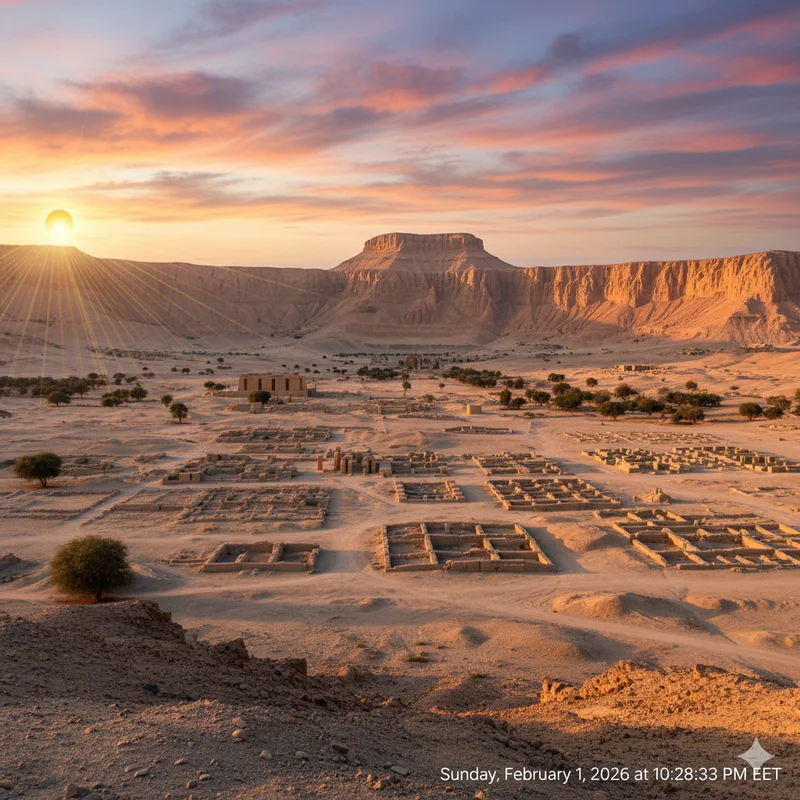
"For a brief, dazzling moment in history, the desert bloomed with a city dedicated to light. Built by the 'Heretic King' Akhenaten, Amarna was a bold experiment in art, religion, and urban planning that challenged thousands of years of tradition."
Amarna (known in ancient times as Akhetaten) is located on the east bank of the Nile in the modern province of Minya. Founded around 1346 BCE by Pharaoh Akhenaten (Amenhotep IV), it was created to be the new capital of Egypt, dedicated solely to the worship of the Aten, the life-giving sun disk. Unlike Thebes or Memphis, which were cluttered with old gods, Amarna was built on virgin soil where "no god had been worshipped before."
The Atenist Revolution
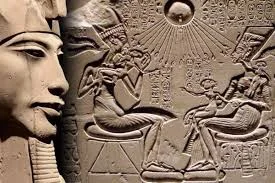
Akhenaten's reign marked a radical shift from polytheism (worship of many gods) to something approaching monotheism. He declared that only the Aten (the visible disk of the sun) was worthy of worship.
Open-Air Temples
Unlike the dark, mysterious sanctuaries of Karnak, temples in Amarna were open to the sky. Hundreds of offering tables were laid out in direct sunlight, allowing the Aten's rays to "touch" the offerings.
The Royal Intermediaries
In the old religion, priests were the bridge to the gods. In Amarna, only Akhenaten and his wife Nefertiti could communicate directly with the Aten. The people worshipped the Royal Family, who in turn worshipped the sun.
The Great Hymn to the Aten
Found inscribed in the tomb of Ay (later a Pharaoh), this hymn is considered one of the masterpieces of ancient religious literature. It bears striking resemblance to Psalm 104 in the Bible.
"Thou appearest beautifully on the horizon of heaven, Thou living Aten, the Beginning of life! When Thou art risen on the eastern horizon, Thou hast filled every land with Thy beauty... When Thou settest in the western horizon, The earth is in darkness like the dead."
Urban Planning & Daily Life
Amarna offers archaeologists a unique snapshot of ancient Egyptian urban life because it was built quickly and abandoned quickly.
- The Boundary Stelae: Akhenaten marked the limits of his holy city with massive rock-cut tablets carved into the surrounding cliffs, swearing an oath never to expand beyond them.
- The Workmen's Village: A walled settlement for the artisans who built the royal tombs. Excavations here have provided immense detail about ordinary life, diet, and personal piety (which often still included household gods like Bes and Taweret, despite the official ban).
- Zoning: The city was distinctly divided into a Central City (admin & religion), North Suburbs, and South Suburbs (residential), interconnected by the wide "Royal Road" designed for chariot processions.
The Amarna Letters: Diplomacy in Clay
One of the most significant discoveries at Amarna was the "Bureau of Correspondence of Pharaoh." Here, over 300 clay tablets written in cuneiform (the diplomatic language of the day) were found.
These letters capture the geopolitical tension of the 14th century BCE. They include desperate pleas from vassal kings in Canaan asking for Egyptian troops to defend against the rising Hittite Empire, as well as correspondence with the "Great Kings" of Babylon, Assyria, and Mitanni discussing royal marriages and gifts of gold.
Nefertiti & The Royal Daughters
Women played an unprecedented role in Amarna art and religion. Queen Nefertiti was not just a consort; she is depicted smiting enemies (a pose usually reserved for the King) and worshipping the Aten on near-equal footing with her husband.
The couple had six daughters: Meritaten, Meketaten, Ankhesenpaaten (who later married Tutankhamun), Neferneferuaten Tasherit, Neferneferure, and Setepenre. Art from this period shows them in touching domestic scenes—eating ducks, playing, or grieving at the death of Meketaten.
The Amarna Art Style
The revolution wasn't just religious; it was artistic. The rigid, idealized forms of the past were replaced by a strange, fluid "naturalism" (or mannerism).
-
Physical Distortions: Figures were depicted with elongated skulls, long necks, pot bellies, and wide hips. Scholars debate whether this reflects Akhenaten's actual physical condition (Marfan syndrome?) or a symbolic artistic choice representing the androgynous nature of the Aten.
-
Intimacy: For the first time, the Pharaoh was shown in intimate, domestic scenes—kissing Nefertiti under the rays of the sun, or bouncing his daughters on his knee.
The End of the Dream
The city's life was short-lived (about 15-20 years). After Akhenaten's death, his successors (Smenkhkare and the young Tutankhamun) abandoned the city and returned to Thebes and the old gods.
Later, General Horemheb and the Ramesside kings dismantled Akhetaten's temples to use the stone as fill for their own projects, attempting to erase the "Heretic King" from history. Paradoxically, this destruction helped preserve many Amarna blocks (talatat) found inside pylons at Karnak and nearby Hermopolis.