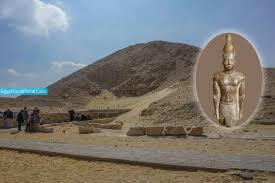
Basic Identity
Teti (also known as Othoes) is the founder of the Sixth Dynasty. His reign marks the political transition from the solar-focused Fifth Dynasty to a period of increasing noble power and internal complexity.
| Name Meaning | “He Who Is Strong” (Debated) |
|---|---|
| Titles | King of Upper & Lower Egypt, Son of Ra |
| Dynasty | Sixth Dynasty (Founder) |
| Reign | c. 2345–2333 BCE (Approx. 12 Years) |
A New Dynasty
Teti is significant for stabilizing the throne after Unas died without a male heir. He legitimized his rule by marrying Iput I (likely Unas's daughter). His reign is pivotal as it sets the stage for the long decline of the Old Kingdom, characterized by the rise of powerful provincial officials.
Dynastic Context
He succeeded Unas and was followed by the mysterious Userkare (who ruled briefly) and then his own son, Pepi I. This succession was not smooth; historical records hint at a violent interregnum.
Marriage Alliance
Teti was likely a commoner or noble who married into the royal family. His marriage to Iput I bridged the gap between the 5th and 6th Dynasties, ensuring that their son Pepi I would have full royal blood.
Elite Support
Teti relied heavily on the support of powerful officials to maintain his throne. His viziers, Kagemni and Mereruka, built mastaba tombs at Saqqara that rivaled the king's own pyramid in size and luxury, a clear sign that the king's absolute power was being diluted.
Decentralization
Teti promoted many officials, increasing the influence of the provincial elite. This policy, while necessary for stability, sowed the seeds of the Old Kingdom's collapse, as local governors (Nomarchs) began to pass their titles down hereditarily, independent of the king.
Continuity of Faith
Despite political turmoil, Teti maintained religious orthodoxy. He continued the solar ideology of Ra and the Osirian funerary beliefs. Most importantly, he copied the tradition of Unas by inscribing his pyramid with Pyramid Texts, ensuring his own divine resurrection.
The Pyramid of Saqqara
Teti built his pyramid complex at North Saqqara. Though originally encased in fine limestone, it has since been stripped, leaving a mound of rubble. However, the substructure remains intact, preserving the precious texts.
Standardized Design
The pyramid followed the standard dimensions established in the late 5th Dynasty. It was not innovative in design but served as a vehicle for the texts. The decline in construction quality compared to Giza reflects the shifting economic priorities of the state.
Expanded Spells
Teti's pyramid contains an expanded version of the Pyramid Texts found in Unas's tomb. These spells were crucial for his journey to the afterlife, providing the magical passwords to bypass the guardians of the sky.
The Ruined Temple
The complex included a mortuary temple, a causeway, and a valley temple. While largely ruined, excavations have revealed evidence of a cult that lasted well into the Middle Kingdom, proving Teti was revered as a local saint long after his death.
The Basalt Sarcophagus
Inside the burial chamber lies Teti's basalt sarcophagus. It is the first to contain inscriptions of the Pyramid Texts on the sarcophagus itself, wrapping the king's mummy in a layer of magical protection.
Powerful Queens
The pyramids of his wives, Iput I and Khuit, are located nearby. The discovery of Iput's pyramid confirmed her royal status and the legitimacy of her son Pepi I. These queens played a critical role in navigating the succession crisis after Teti's murder.
The Userkare Mystery
Upon Teti's death, Userkare took the throne for a brief period (1-5 years). It is debated whether he was a usurper involved in the assassination or a regent ruling for the young Pepi I. He eventually disappeared from history, allowing Teti's line to continue.
Internal Focus
There is little evidence of major foreign campaigns during Teti's reign. The focus was likely on internal consolidation and suppressing the rising power of the nobility, a task that ultimately proved fatal for the king.
Wealth of Officials
The economy was robust enough to support massive private tombs. The mastaba of Mereruka, Teti's vizier, contains 32 rooms and depicts vast estates, herds of cattle, and workshops, indicating that immense wealth was being diverted from the crown to private individuals.
The Beginning of the End
Teti represents the tipping point of the Old Kingdom. While still a powerful god-king, his reliance on nobles and his eventual assassination signaled that the inviolable aura of the Pharaoh was fading. He stands at the edge of the decline that would lead to the First Intermediate Period.
Evidence
Evidence for his reign comes from the Manetho history, the Abydos King List, and the extensive necropolis at Saqqara. The recent discovery of new pyramids near Teti's complex continues to rewrite the history of this turbulent time.
A Mysterious End
Historians still debate the details of Teti's death. Was it a harem conspiracy? A guard's betrayal? Or a political coup by Userkare? Regardless, Teti remains a tragic figure—a founder who stabilized a dynasty only to become a victim of the very forces he empowered.
📌 Comprehensive Summary
👑 Name: Teti (He Who is Strong)
🕰️ Era: 6th Dynasty (Founder)
⚔️ Key Event: Assassination by Bodyguards
🪨 Monument: Pyramid at Saqqara