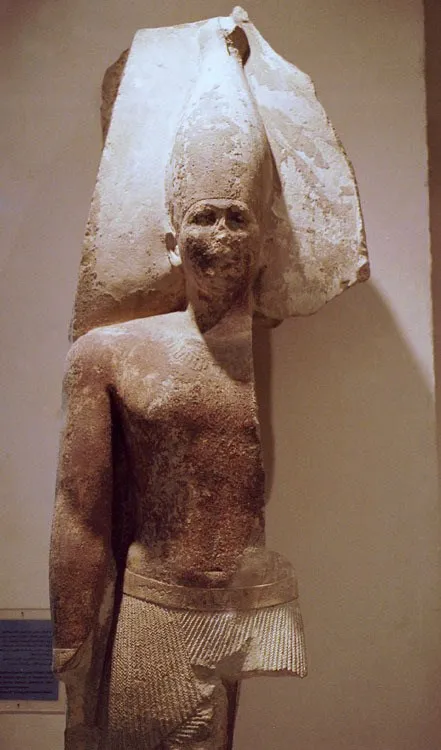
King Sneferu
The greatest pyramid builder in history and father of Khufu.
(Sneferu, "He has Perfected")
Sneferu the Benevolent, Founder of a Golden Age
Sneferu, whose name means "He has Perfected," founded the glorious Fourth Dynasty and ruled for approximately 24 years. Unlike his son Khufu, who was often depicted in later folklore as a tyrant, Sneferu was remembered for millennia as a good, just, and accessible king. The Westcar Papyrus, a collection of stories written long after his death, portrays him as an affable ruler who addressed commoners as "my brother."
But his kindness was matched by a formidable will. He inherited a stable kingdom from his father Huni and used its full might to embark on an unparalleled building spree, moving more stone than any other ruler in Egyptian history—surpassing even Khufu. His reign was not just about building tombs; it was about perfecting them, a relentless pursuit that laid the foundation for the wonders of Giza.
The Pyramid Trilogy: An Epic of Engineering
Sneferu’s architectural legacy is a dramatic three-act play of failure, crisis, and ultimate triumph, resulting in the birth of the true pyramid.
- Act I: The Meidum Failure. Sneferu’s first act was to complete the step pyramid at Meidum. He then ordered a radical conversion: filling in the steps to create a smooth, straight-sided pyramid. The experiment failed when the outer casing collapsed due to unstable foundations, teaching his engineers a hard lesson in physics.
- Act II: The Bent Pyramid (Evolution in Stone). Moving to Dahshur, Sneferu began his second pyramid with a steep 54° angle. Halfway through, structural cracks appeared due to the soft clay subsoil. To prevent collapse, architects reduced the angle to 43° for the top half, creating the iconic "Bent" shape. It stands as a monument to ancient problem-solving.
- Act III: The Red Pyramid (The First True Pyramid). Refusing to accept defeat, Sneferu ordered a third pyramid. Applying lessons learned, engineers built the Red Pyramid at a safe 43° angle from the start. The result was a resounding success: the world's first large-scale, stable, true pyramid. This magnificent structure became the blueprint for the Great Pyramid of Giza.
Folklore: The King and the Turquoise Pendant
One of the most famous stories from the Westcar Papyrus ("The Magicians") features Sneferu. Feeling bored, the king is advised by his lector priest to go boating on the palace lake. He orders a boat rowed by beautiful women clad in fishnet nets. During the trip, the stroke rower drops her precious fish-shaped turquoise pendant into the water and stops rowing in distress.
Sneferu, showing his characteristic kindness, offers to replace it. She refuses, wanting her own specific jewel. The king then calls the magician Djadjaemankh, who folds the waters of the lake in half (placing one side of the water atop the other), retrieves the pendant from the dry lakebed, and returns it to the girl. The waters are then unfolded. This story highlights Sneferu's human side and his role as a patron of magic and wonder.
Powering the State: Conquest and Commerce
These colossal building projects required immense resources, and Sneferu was a master of state-level logistics and foreign policy. The Palermo Stone, an ancient royal annal, records the activities that funded his ambitions:
- The Cedar Fleet: The stone records the arrival of "forty ships filled with cedar wood" from Byblos in Lebanon. This timber was indispensable for building large funerary boats, temple doors, and construction scaffolding.
- Military Campaigns: It documents massive campaigns into Nubia (capturing 7,000 prisoners and 200,000 cattle) and Libya, securing labor and resources for his projects.
- Mining: Sneferu secured the turquoise mines of Sinai, where reliefs depict him "smiting the Bedouin," earning him the title "Smiter of Barbarians" for centuries.
The Royal Family: A Glimpse into Luxury
Sneferu's principal wife was **Queen Hetepheres I**, mother of Khufu. Her secret tomb cache at Giza revealed the incredible artistry of Sneferu's court. It contained gilded furniture, a portable canopy, and silver bracelets inlaid with butterfly designs in turquoise, lapis lazuli, and carnelian. These treasures prove the extreme wealth and artistic sophistication that defined his golden age.
Legacy: The Father of the Pyramid Age
Sneferu's legacy is the Giza Plateau itself. Without his trials at Meidum and Dahshur, the Great Pyramid would not exist. By the end of his reign, he had perfected the engineering, logistics, and state organization needed to build mountains of stone. He left his son Khufu a wealthy, stable nation and the blueprint for immortality.
Art of the Era: The famous "Meidum Geese" frieze, found in the mastaba of his son Nefermaat, dates to this period. Its incredible realism and color make it one of the masterpieces of ancient Egyptian art.