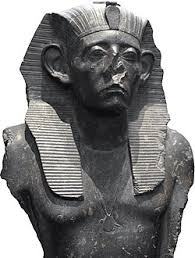
Basic Identity
Senusret III (Sesostris III) is considered the most powerful warrior-pharaoh of the Middle Kingdom. Reigning for nearly four decades, he fundamentally reshaped the Egyptian state, transforming it from a feudal system into an absolute military monarchy.
| Throne Name | Khakaure (“The Ka of Ra Appears”) |
|---|---|
| Horus Name | Netjerkheperu (“Divine of Manifestations”) |
| Dynasty | 12th Dynasty |
| Reign | c. 1878–1839 BCE (Approx. 39 Years) |
The Iron Fist
He is famous for two major achievements: the final subjugation of the independent provincial nobility (Nomarchs) and the brutal, permanent conquest of Nubia. He redefined the role of the king from a distant god to a terrifying, vigilant commander.
Inheriting a Complex State
When he ascended, Egypt was prosperous but politically fractured. Powerful families in the provinces still held significant sway. Senusret III chose confrontation over compromise, determined to center all authority in himself and his capital at Itjtawy.
War in the South
He led at least four massive campaigns into Nubia (Kush). Unlike his predecessors who raided for goods, Senusret III sought total domination. He cut a canal through the granite rocks of the First Cataract to allow his war fleet to pass swiftly, pushing the border south to the Second Cataract at Semna.
The Semna Stela
At the border, he erected famous boundary stelae with aggressive inscriptions. He declared: "I have established my boundary further south than my fathers... As for any son of mine who shall maintain this boundary, he is my son... but he who shall abandon it, he is not my son." This defined the psychological and physical limits of Egypt.
End of the Nomarchs
Domestically, his reign saw the disappearance of the great provincial tombs that characterized the power of local governors. Senusret III effectively abolished the hereditary power of the Nomarchs, replacing them with a central bureaucracy of three departments (North, South, and Head of the South) answering directly to the Vizier.
Magic as a Weapon
Archaeologists have found thousands of Execration Texts from his reign at Nubian forts. These were clay figurines or bowls inscribed with the names of foreign enemies and rebellious Egyptians. They were smashed in ritual ceremonies to magically destroy the enemies of the state, showing that he used both steel and spells to rule.
The Face of Reality
His statues mark a radical departure from the idealized youth of earlier kings. Senusret III is depicted with heavy eyelids, deep creases, and a brooding, weary expression. This Psychological Realism portrays the king not just as a god, but as a ruler bearing the heavy burden of responsibility and vigilance.
The Living God
Unusually, Senusret III was deified during his own lifetime, particularly in Nubia where he was worshipped as a patron god of the region. Temples were built to him at the border forts, where soldiers offered prayers to their warrior-king for protection.
Dahshur Complex
He built his pyramid at Dahshur, using a mudbrick core encased in limestone. The complex is famous for the "Treasure of Dahshur," exquisite jewelry belonging to his queens found hidden in the galleries. The pyramid lacked a standard entrance, using a hidden shaft to fool robbers—an innovation in security.
The Hidden Tomb
Wealth of Empire
The centralized control of resources led to economic efficiency. Gold from Nubia flowed into the treasury, funding temple construction and military wages. Trade with the Levant continued, but under strict state regulation, ensuring the crown monopolized foreign luxury goods.
A Strong Inheritance
He was succeeded by his son, Amenemhat III, who inherited a pacified, wealthy, and highly organized state. The stability achieved by Senusret III's harsh reforms allowed his son to focus on the peaceful economic exploitation of the Faiyum oasis.
Order vs. Power
| King | Senusret I | Senusret III |
|---|---|---|
| Style | Builder / Traditional | Warrior / Reformer |
| Nobility | Managed / Co-opted | Crushed / Replaced |
| Art | Classical Idealism | Psychological Realism |
📌 Comprehensive Summary
👑 Name: Senusret III (Khakaure)
🕰️ Era: 12th Dynasty (Peak)
⚔️ Achievement: Conquest of Nubia & Centralization
🪨 Monument: Fortress Chain & Dahshur Pyramid