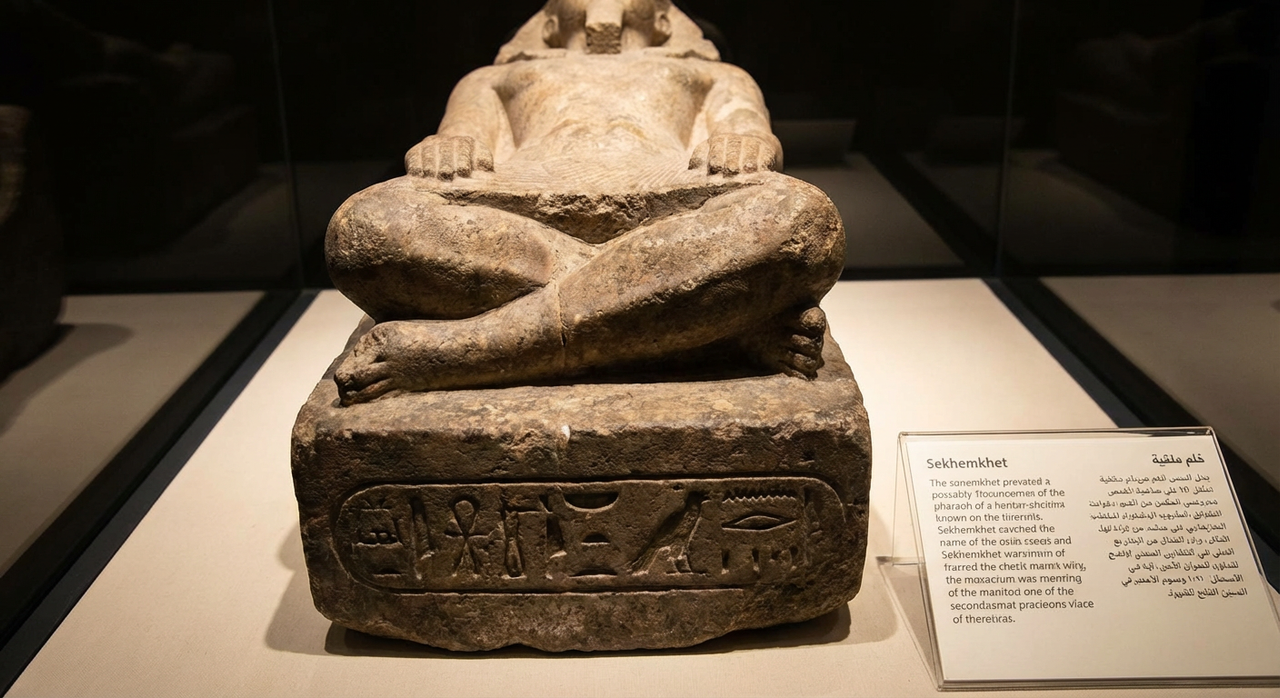
Sekhemkhet
The pharaoh of the unfinished "Buried Pyramid."
(Sekhemkhet, "Powerful of Body")
🕰️ Reign
c. 2648–2640 BCE
🏆 Monument
The Buried Pyramid
🏛️ Predecessor
Djoser
⏳ Status
Reign Unfinished
The Heir to a Revolution
Sekhemkhet, whose name means "Powerful of Body," inherited the most prosperous and technologically advanced kingdom the world had yet seen. As the successor to the legendary Djoser, he was poised to continue the architectural revolution that had just begun. He commanded a unified nation, a loyal administration, and, most importantly, the visionary architects and skilled stonemasons who had just completed the world's first pyramid. The expectation was clear: he would build upon his predecessor's legacy and create something even grander.
The Buried Pyramid: Discovery of a Lost King
For millennia, Sekhemkhet was little more than a name on a king list. His story remained lost until 1951, when Egyptian archaeologist Zakaria Goneim noticed a strange, rectangular shape in the desert at Saqqara. He began to excavate what he believed to be an unfinished pyramid enclosure. What he found was the rediscovery of a lost pharaoh.
The project was ambitious: a massive enclosure and a step pyramid planned to have seven steps, soaring to over 70 meters—taller and more refined than Djoser's. But construction had barely begun, with only the first step reaching a height of a few meters. The reason became clear: the king's reign was tragically short. Despite this, the subterranean structure was complete, and deep within, Goneim found the burial chamber. There stood a breathtaking sight: a single, magnificent sarcophagus carved from a block of translucent alabaster, its sliding portcullis door still sealed with plaster. It had remained untouched for over 4,600 years.
The Mystery of the Empty Sarcophagus
The discovery of a sealed, intact royal sarcophagus from the Old Kingdom was one of the greatest archaeological finds of the 20th century. The world held its breath. On June 26, 1954, before government officials and the international press, Goneim and his team prepared to open the sarcophagus. With immense effort, they raised the heavy sliding door.
They peered inside. It was completely, utterly empty. There was no mummy, no jewelry, no artifacts. The discovery was as baffling as it was disappointing. How could a perfectly sealed sarcophagus, untouched since the day it was closed, be empty? This question has given rise to several compelling theories:
- Theory 1: A Cenotaph. The most popular theory is that the Buried Pyramid was a symbolic tomb or cenotaph. Sekhemkhet may have been buried elsewhere (perhaps in a yet-undiscovered tomb) and this complex served a purely ritual purpose.
- Theory 2: A Change of Plans. It's possible the king's premature death meant his burial plans were hastily changed. He may have been interred in the pyramid's "South Tomb" or another simpler structure that has since been destroyed or looted.
- Theory 3: An Incredibly Clever Robbery. While unlikely, some speculate that ancient robbers found a way to remove the contents without disturbing the main seals, perhaps through a small, hidden hole that was later resealed.
Architectural Significance: "Pyramid 2.0"
The Imhotep Connection: Proof of continuity was found on the enclosure wall—a red ink inscription naming the famous architect Imhotep. This confirms he survived Djoser and continued to serve as the royal architect for Sekhemkhet, applying his genius to this second attempt at a pyramid.
The Treasures of the North
While the sarcophagus was empty, the pyramid complex was not without its wonders. In the main corridor, Zakaria Goneim discovered a hoard of gold jewelry that had escaped the notice of tomb robbers. This find is one of the oldest collections of royal gold jewelry ever found in Egypt.
- The Gold Bracelets: 21 gold bracelets were found, shaped like bivalve shells.
- The Cosmetic Vessel: An exquisite gold shell-shaped container for cosmetics, complete with a lid.
- Tools of State: Electrum tweezers and a needle were also found, hinting at the refined personal care of the royal court.
These artifacts, now in the Egyptian Museum, provide a rare glimpse into the wealth and craftsmanship of the Third Dynasty, proving that Sekhemkhet's reign, however short, was one of immense opulence.
The Sinai Inscriptions: Proof of Power
Sekhemkhet was not an idle king. Far from Saqqara, at Wadi Maghareh in the Sinai Peninsula, stunning rock reliefs depict him in the traditional "smiting the enemy" pose. These inscriptions serve two vital purposes: they prove his active foreign policy and interest in mining turquoise and copper, and they confirm his identity by linking his Horus name (Sekhemkhet) with his birth name (Djeser-Teti), solving a major historical puzzle for Egyptologists.
Legacy: The Enduring Puzzle
Sekhemkhet's reign was too short to leave a major mark on history through conquests or grand edicts. His legacy is his phantom pyramid and its unsolved puzzle. He is a testament to the fact that even for a divine king with unlimited resources, grand ambitions can be cut short by fate. His project, frozen at the moment his reign ended, offers a unique window into the minds of the ancient builders and leaves us with one of Egypt's most tantalizing questions: what really happened to the body of King Sekhemkhet?