
"Before the great pyramids rose from the sands of Giza, and before the first Pharaoh wore the Double Crown, there was Predynastic Egypt—a fascinating era of innovation, artistic explosion, and the gradual birth of one of the world's greatest civilizations."
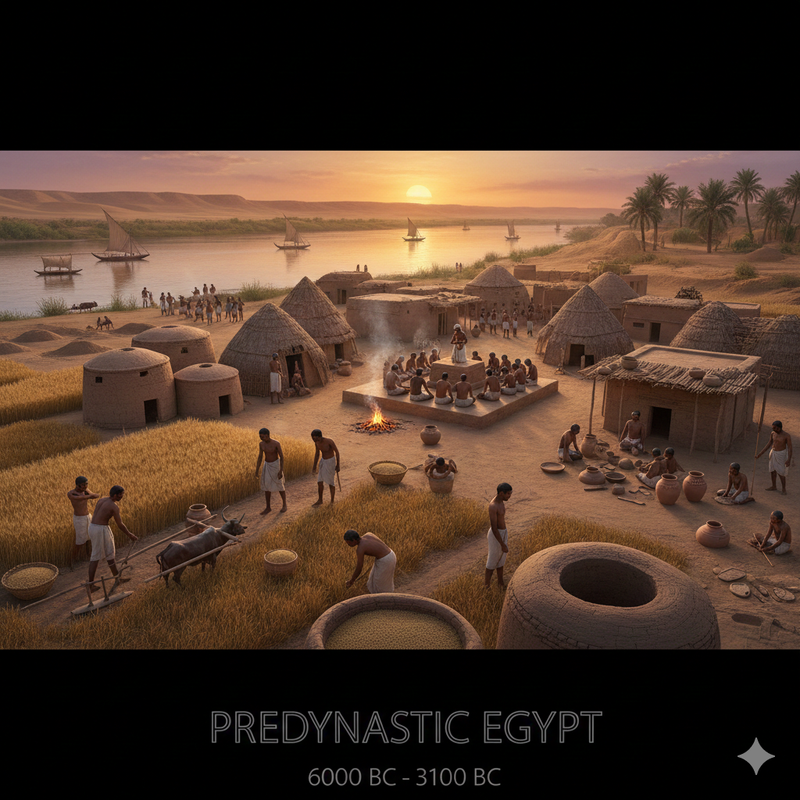
The Predynastic Period of Egypt (spanning roughly from 6000 BC to 3100 BC) represents the formative years of Ancient Egyptian civilization. It was during this time that the foundations of Pharaonic culture were laid: the development of agriculture, the establishment of social hierarchy, the evolution of religious beliefs, and the mastery of crafts such as pottery and stone working.
The Cultural Phases
Scholars divide the Predynastic period into distinct cultural phases, named after the sites where their artifacts were first discovered. The development happened largely in two distinct regions: Lower Egypt (the Delta) and Upper Egypt (the Nile Valley).
1. The Badarian Culture (c. 4400–4000 BC)
Located in Upper Egypt, the Badarian culture provides the earliest evidence of agriculture in the region. The people lived in small villages and were semi-nomadic.
- Key Characteristic: Famous for their incredibly high-quality pottery, known as "Black-topped Red Ware." These vessels were polished to a metallic sheen and had a distinct blackened rim.
- Burial Customs: The dead were buried in oval pits, curled on their sides facing west, often accompanied by grave goods like ivory spoons and jewelry, indicating an early belief in the afterlife.
2. The Naqada Period (c. 4000–3100 BC)
Named after the site of Naqada (ancient Nubt), this culture gradually replaced the Badarian and spread throughout Egypt. It is divided into three sub-phases:
Naqada I (Amratian)
Rise of the elite. Pottery featured white painted designs (animals, plants) on red backgrounds. Cosmetic palettes made of slate began to appear.
Naqada II (Gerzean)
Rapid expansion. Contact with Mesopotamia increased. Pottery shifted to buff-colored clay with dark red painting, depicting boats and landscapes.
3. Naqada III (The Protodynastic Period)
This is the final stretch before history "begins." This era saw the emergence of powerful regional rulers (proto-kings) and the beginnings of writing. Cities like Hierakonpolis (Nekhen), Naqada, and Abydos became powerful centers of influence.
Masterpieces of the Era
The art of this period wasn't just decorative; it was functional and magical.
The Cosmetic Palettes
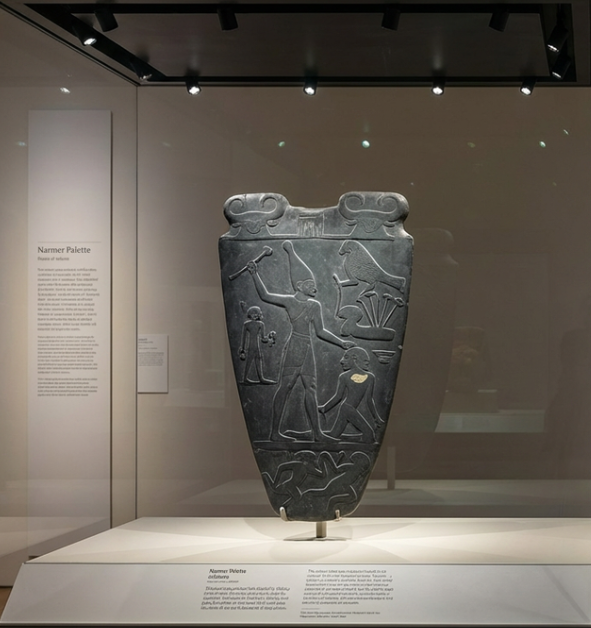
Originally used to grind kohl (eye makeup) for protection against the sun, these slate palettes evolved into ceremonial canvases. The most famous is the Narmer Palette, which many historians believe depicts the unification of Upper and Lower Egypt by King Narmer.
Stone Vessels
Craftsmen mastered the art of carving the hardest stones (basalt, granite, diorite) into perfect vessels using only stone tools and sand abrasives.
The Unification (c. 3100 BC)
The end of the Predynastic period is marked by the unification of the "Two Lands." While legend attributes this to a single king named Menes (often identified with Narmer), archaeology suggests a gradual process of political consolidation where the culture of Upper Egypt (Naqada) slowly spread north, integrating with the Delta.
This moment marks the beginning of the Early Dynastic Period (Dynasties 1 & 2), setting the stage for 3,000 years of Pharaonic history.