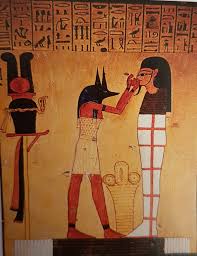
Definition & Meaning
The Opening of the Mouth (Ancient Egyptian: Wep-r) is a complex ritual performed on a mummy, coffin, or statue to magically restore its senses. It is the moment when the inanimate object becomes a living vessel for the soul, capable of breathing, speaking, eating, and seeing in the afterlife.
| Ancient Name | Wep-r (Opening of the Mouth) |
|---|---|
| Goal | Reanimation & Restoration of Senses |
| Recipients | Mummies, Statues, Shabtis |
| Key Tool | The Adze (Mshtyw) |
Life After Death
In Egyptian belief, preservation of the body (mummification) was not enough. The body was physically intact but spiritually asleep. Without the ability to breathe or eat, the Ka would starve, and the Ba would be trapped. This ritual "switched on" the biological functions in a magical sense, transforming the corpse into an Akh (effective spirit).
Restoring the Senses
The ritual aimed to reverse the effects of death:
- Mouth: Opened for speech (to defend oneself in judgment) and eating.
- Nose: Opened to breathe the breath of life.
- Eyes: Opened to see the sun god Ra.
- Ears: Opened to hear the prayers of the living.
Horus & Osiris
The ritual reenacts the myth of Osiris. After Osiris was murdered, his son Horus fought Set to reclaim the throne. During the battle, Horus lost his eye but recovered it. He offered this "Eye of Horus" to his dead father, an act that revived Osiris. In the ritual, the priest plays the role of Horus reviving his father (the deceased).
The Sem Priest
The ceremony was conducted by the Sem Priest, who wore a distinctive leopard-skin robe. He was often the eldest son of the deceased (acting as Horus). Other participants included the Kher-heb (Lector Priest) who read the spells, and the embalmers. It took place at the tomb entrance, the "Place of Truth," just before the mummy was sealed away forever.
Sacred Tools
The priest used a specific set of tools, each with symbolic meaning:
| Tool | Function | Symbolism |
|---|---|---|
| Adze (Mshtyw) | Touches lips | Carpentry tool; shaping the soul. |
| Peseshkef | Fishtail Knife | Cutting the umbilical cord (Birth). |
| Netjerwy | Iron Blades | Blades of the North & South. |
| Incense | Purification | Scent of the gods. |
The Peseshkef is particularly interesting; its shape resembles the flint knife used by midwives to cut the umbilical cord, emphasizing that this ritual is a "second birth."
Beyond the Mummy
The ritual was versatile. It was performed on the mummy itself, but also on the anthropoid coffin, the funerary mask, and any statues (Ka statues) placed in the tomb. This ensured that even if the physical body was destroyed, the statues could serve as backup vessels for the soul, fully capable of consuming offerings.
Words of Power
The Lector Priest recited ancient spells from the Pyramid Texts or the Book of the Dead. A common formula was: "My mouth is opened by Ptah, My mouth's bonds are loosed by my city-god. Thoth has come fully equipped with spells, He looses the bonds of Seth from my mouth." These words activated the magic of the tools.
Functional Immortality
The ritual systematically restored every function:
- Mouth: Ability to speak the truth in judgment and eat food.
- Eyes: Ability to see the path through the Duat.
- Limbs: Ability to walk and work in the Field of Reeds.
- Heart: Ability to remember and feel.
Reunion of Parts
This ceremony was the catalyst that allowed the spiritual components to function. It opened the way for the Ba (bird-soul) to re-enter the body at night. It allowed the Ka to absorb the essence of food offerings. Without it, the soul parts would remain disjointed and powerless.
Symbolism of Creation
The ritual mimics the creation of the world. Just as the creator god Ptah spoke the world into existence ("thought in the heart, spoken on the tongue"), the priest speaks life back into the deceased. It connects the personal rebirth of the individual with the daily rebirth of the sun.
Evolution of the Rite
Starting as a simple offering rite in the Old Kingdom, it grew into a massive liturgy. By the New Kingdom, it involved up to 75 separate scenes or stages, including purification, annointing, clothing the statue, and the presentation of a feast. It was performed for kings, nobles, and eventually commoners.
Evidence in Stone
We know this ritual in great detail because it is depicted on the walls of many tombs (such as the tomb of Seti I and the tomb of Rekhmire). Sets of model tools—miniature adzes and vessels—are frequently found in burial equipment, ensuring the deceased had the means to perform the ritual on themselves if necessary.
The Final Door
The Opening of the Mouth was the final act of the funeral. It was the "Big Bang" of the afterlife journey. It transformed the end of a physical life into the beginning of a spiritual one. Without it, the meticulously preserved mummy was just a shell; with it, it became a god.
Encyclopedia Summary
| Ritual | Opening of the Mouth |
|---|---|
| Performer | Sem Priest (Son of Deceased) |
| Key Act | Touching lips with Adze |
| Key Offering | Foreleg of a Bull |
| Outcome | Restoration of Life & Senses |