Definition & Essence
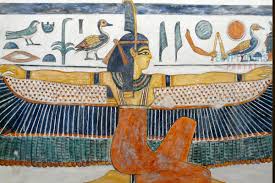
Ma'at is the single most important concept in Ancient Egyptian thought. It is not just a goddess, but the fundamental state of the universe: Order, Truth, Justice, and Balance. It is the correct way things must be for the cosmos to function.
| Concept Name | Ma'at |
|---|---|
| Opposite | Isfet (Chaos/Falsehood) |
| Scope | Universal (Cosmic, Social, Moral) |
| Goal | Stability and Continuity |
The Cosmic Glue
The word "Ma'at" implies "that which is straight" or "true." It encompasses physical laws (gravity, sunrise), social laws (justice, kingship), and moral laws (truth-telling). It is the unwritten constitution of the universe, the cohesive force that prevents the world from dissolving back into the primordial waters (Nun).
The Eternal Struggle
Ma'at exists in eternal tension with Isfet (Chaos, injustice, violence). The world is not naturally stable; it requires constant effort to maintain Ma'at. Every act of truth strengthens order; every lie or act of violence feeds Isfet. History was seen as a cycle of order being established, lost to chaos, and restored again.
The First Principle
In the beginning, the Creator God (Atum/Ra) emerged from chaos and "established Ma'at." Before creation, there was no order. Ma'at was the platform upon which the god stood to create the world. She is the daughter of Ra, born the moment the universe began, signifying that order and existence are inseparable.
Sustenance of the Divine
The gods do not just enforce Ma'at; they live on it. Ancient texts state that the gods "eat Ma'at and drink Ma'at." This metaphorical idea means that divine power thrives only where there is order and justice. Without Ma'at, even the gods would starve and fade away.
The Pharaoh's Mandate
The legitimacy of the Pharaoh depended entirely on his ability to "uphold Ma'at and drive out Isfet." A successful reign was marked by the regular flooding of the Nile and social peace—proof that Ma'at was present. A King who failed to enforce justice was seen as having lost the divine mandate.
Living in Truth
For the ordinary Egyptian, Ma'at was a code of conduct. It meant speaking the truth, dealing fairly in business, helping the weak, and respecting hierarchy. "Doing Ma'at" was a religious act. The concept linked the mundane (accurate weights in the market) with the divine (the balance of the cosmos).
The Final Scales
Eternal life was not a gift of grace but a reward for Ma'at. In the Hall of Judgment, the deceased's heart was weighed against the Feather of Ma'at. If the person had lived a chaotic, unjust life, their heart would be heavy with "Isfet" and they would perish. Only a heart light with truth could enter eternity.
The Declaration of Innocence
The "Negative Confessions" in the Book of the Dead are essentially a checklist of Ma'at. The deceased asserts: "I have not stolen, I have not killed, I have not lied." This declaration was a magical assertion that the individual's life had aligned with the divine order.
The Ostrich Feather
The symbol of Ma'at is the Ostrich Feather (Shu feather). Its barbs are of equal length on both sides of the central shaft, representing perfect balance and symmetry. It is light, representing a conscience free from the heaviness of guilt and sin.
The Cohesive Force
Ma'at was the glue that held Egyptian civilization together for 3,000 years. It unified religion, politics, law, and ethics into a single coherent system. It provided a sense of security and predictability in a world that could otherwise be chaotic and terrifying.
Ancient Ethics
Ma'at represents one of the earliest developed moral philosophies in human history. It predates Greek philosophy by millennia. Unlike systems based on divine command ("do this because God said so"), Ma'at is based on natural law ("do this because it is the nature of the universe").
Legacy
Scholars study Ma'at to understand the Egyptian mind. It reveals a society deeply concerned with responsibility, community, and the interplay between human action and cosmic reaction. It challenges modern views by presenting a world where justice is as objective as gravity.
Encyclopedia Summary
| Concept | Ma'at (Cosmic Order/Truth) |
|---|---|
| Visual Symbol | Ostrich Feather / Seated Woman |
| Primary Text | Book of the Dead (Spell 125) |
| Key Ritual | Offering of Ma'at by the King |
| Philosophy | Order vs. Chaos (Isfet) |