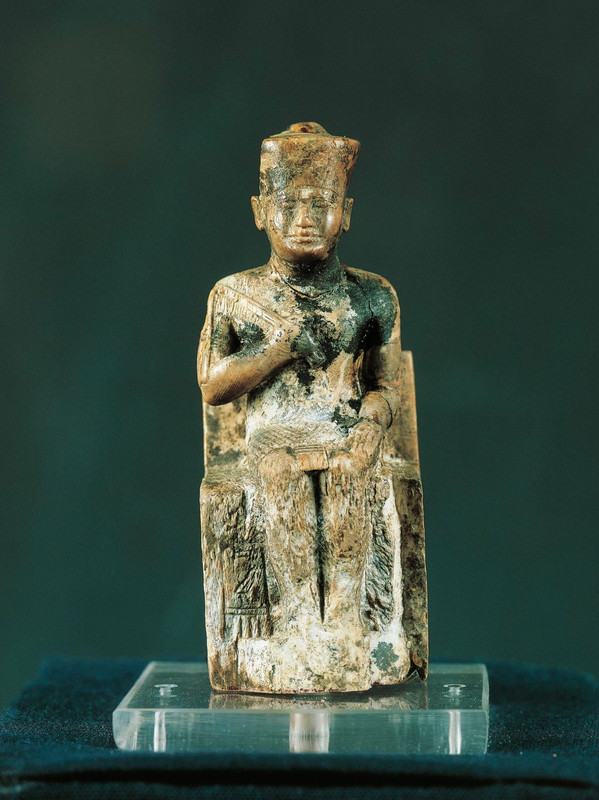
King Khufu
The pharaoh who built the Great Pyramid of Giza.
(Khufu)
Akhet Khufu: "The Horizon of Khufu"
Khufu's Great Pyramid is not merely a tomb; it is a masterpiece of mathematics, logistics, and engineering that has baffled and fascinated humanity for over 4,500 years. For more than 3,800 years, it stood as the tallest man-made structure on Earth, a symbol of the absolute power and divine status of the pharaoh.
- Colossal Scale: Constructed from an estimated 2.3 million stone blocks, weighing a total of 6 million tons, its original height was a staggering 146.6 meters (481 ft).
- Astronomical Precision: The pyramid is aligned to true north with an accuracy of within 3/60th of a degree. The so-called "air shafts" are not for ventilation; they are precisely angled to point to specific circumpolar stars (like Thuban, the pole star of that era) and the constellation of Orion, linking the king's soul directly to the indestructible, eternal stars.
Inside the Horizon: The Architecture Within
Unlike other pyramids that have simple substructures, Khufu's pyramid contains a complex system of chambers high above ground level, showing the evolution of the royal plan during construction.
- The Subterranean Chamber: Carved deep into the bedrock but left unfinished, suggesting an initial plan to bury the king below ground that was later abandoned.
- The Queen's Chamber: Located in the middle of the structure. Despite its name (given by early explorers), it was likely a "Serdab" room for the king's Ka statue, not a burial place for a queen. It features mysterious shafts blocked by limestone doors with copper handles.
- The Grand Gallery: An engineering marvel. This 47-meter-long corbelled hall has a soaring 8.6-meter high ceiling. It served a dual purpose: as a ceremonial pathway and a mechanism to store the massive granite blocks used to seal the Ascending Passage.
- The King's Chamber: The heart of the pyramid, built entirely of red Aswan granite. It contains the lidless granite sarcophagus. Above it lie five "relieving chambers" designed to distribute the immense weight of the masonry above, preventing the burial chamber from collapsing.
The Myth of the Tyrant: Who Really Built the Pyramids?
The Greek historian Herodotus, writing 2,000 years after Khufu's reign, painted him as a cruel tyrant who enslaved 100,000 men to build his monument. For centuries, this was the accepted story. Modern archaeology, however, tells a very different tale.
The Diary of Merer: A First-Hand Account
The most stunning blow to the slavery myth came in 2013 with the discovery of the **Wadi al-Jarf Papyri**. These documents include the logbook of an official named Merer, who led a team of 40 elite workers. Merer's diary, the oldest papyrus ever discovered, provides a day-by-day account of his team's work during the final years of Khufu's reign.
He describes quarrying the fine white Tura limestone used for the pyramid's outer casing, loading it onto boats, and sailing it down the Nile and through a series of canals directly to the Giza harbor (Ro-She Khufu). This incredible document gives us names, dates, and logistics, proving the Great Pyramid was built by a highly organized, state-managed workforce of skilled Egyptians.
The Solar Ships: Journey to the Afterlife
In 1954, near the southern face of the Great Pyramid, archaeologists discovered a sealed pit containing a dismantled cedarwood ship. Known as the **Khufu Solar Ship**, it is one of the oldest, largest, and best-preserved vessels from antiquity.
- Design: The ship is 43.6 meters long and was constructed using "sewn" planks of Lebanese cedar, without a single nail. It was likely used to transport the king's body from Memphis to Giza or intended symbolically for his journey with the sun god Ra across the heavens.
- Second Boat: A second boat pit was excavated in recent years, and its contents are being restored to join the first ship in the new Grand Egyptian Museum (GEM).
The Royal Court & The Masterminds
Khufu did not act alone. He was surrounded by a brilliant and powerful family who managed the state.
- Hemiunu (The Architect): Khufu's nephew and vizier. He is credited as the mastermind behind the Great Pyramid. His statue, found at Giza, depicts a man of great authority and corpulence, a sign of prosperity.
- Ankhhaf: Khufu's half-brother, who served as vizier during the later part of the reign. He likely oversaw the completion of the pyramid complex. His realistic bust is a masterpiece of Old Kingdom art.
- Queen Hetepheres I: Khufu's mother and the link to the previous dynasty. Her secret tomb at Giza contained dazzling gold furniture, proving the immense wealth of the royal house.
Succession and the Family Drama
Khufu had several wives and many children, which led to a complex succession after his death. It was not his famous son Khafre who immediately succeeded him. The throne first passed to another son, **Djedefre**.
In a move that suggests a possible family rift or religious shift, Djedefre abandoned Giza and began building his own pyramid complex at Abu Rawash, several kilometers to the north. He was also the first pharaoh to officially adopt the title "Son of Ra," cementing the solar cult's dominance. Only after Djedefre's reign did the throne return to Giza with Khafre.
Modern Science: The "Big Void"
The Great Pyramid has not revealed all its secrets. In 2017, the **ScanPyramids** project, using cosmic-ray muon radiography, announced the discovery of a massive empty space within the pyramid, dubbed the "Big Void."
Legacy: The Man and the Monument
It is the greatest irony of Khufu's reign that the man who built the largest monument in ancient history is known to us by only one confirmed, complete statue: a tiny, 7.5 cm (3-inch) ivory figurine discovered not at Giza, but hundreds of kilometers away in Abydos. While Herodotus painted him as a tyrant, Egyptian sources like the Westcar Papyrus show him as a king fascinated by magic and the limits of knowledge.
In the end, Khufu's personality is eclipsed by his creation. The Great Pyramid is his true legacy. It is the ultimate statement of divine kingship and human potential, a man-made mountain of stone and mathematics designed to launch the king's soul into the eternal cosmos. It is a monument so perfect and so audacious that it continues to define our perception of ancient Egypt and stands as a permanent challenge to the limits of human achievement.