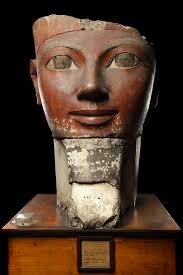
Basic Identity
Hatshepsut (Maatkare) is one of the most successful and intriguing pharaohs in history. Daughter of Thutmose I, she ascended the throne not as a queen, but as a King. Ruling for over 20 years, she brought immense prosperity to Egypt through trade rather than war, leaving behind an architectural legacy that still stuns the world.
| Throne Name | Maatkare (“Ma’at is the Soul of Ra”) |
|---|---|
| Dynasty | 18th Dynasty |
| Reign | c. 1479–1458 BCE (Approx. 21 Years) |
| Capital | Thebes (Waset) |
The Female King
Her significance lies in her unprecedented rise to power. Originally regent for her stepson Thutmose III, she gradually assumed full pharaonic titles. She did not rule as a "Queen Regent" but as a "King," using male iconography (the kilt, the nemes, the false beard) to legitimize her authority in a patriarchal society.
Divine Birth
To justify her unconventional rule, she created the myth of her Divine Birth. In reliefs at Deir el-Bahari, the god Amun-Ra visits her mother, Queen Ahmose, in the form of Thutmose I, conceiving Hatshepsut. She claimed that Amun himself had chosen her to sit on the Horus Throne, bypassing earthly laws of succession.
Djeser-Djeseru
Her masterpiece is the mortuary temple at Deir el-Bahari ("Holy of Holies"). Designed by her architect Senenmut, its three terraced levels blend perfectly with the towering limestone cliffs of Thebes. It was a revolutionary building, featuring colonnades, gardens of frankincense trees, and chapels dedicated to Amun, Hathor, and Anubis.
Journey to God's Land
Her most famous achievement was the trade expedition to the Land of Punt (modern Eritrea/Somalia). Five massive ships returned laden with gold, ebony, ivory, leopard skins, and live myrrh trees (which she planted at her temple). This mission was a triumph of logistics and diplomacy, celebrated in detail on her temple walls.
Piercing the Sky
She erected four massive granite obelisks at Karnak to honor Amun. One still stands today—the tallest surviving ancient obelisk in Egypt (29.5 meters). Its inscription proudly declares: "I have done this with a loving heart for my father Amun... let not anyone who sees my monument say 'what is this?', but rather 'how like her it is!'"
The Great Steward
Senenmut was her most trusted official, architect, and tutor to her daughter Neferure. His rapid rise from commoner to the "Great Steward of Amun" fueled rumors of a romance. He was granted the rare privilege of building his tomb near hers, and his image appears secretly behind doors in her temple, watching over her forever.
Wealth & Restoration
Hatshepsut declared: "I have restored that which was ruined." She repaired temples neglected since the Hyksos occupation. Her reign was a time of economic boom; trade networks were re-established, and the treasury overflowed, funding her ambitious building projects without the need for plunder.
Peace through Strength
Though known for peace, she was not a pacifist. She led campaigns into Nubia early in her reign and possibly into the Levant to secure borders. However, she preferred to project power through trade and magnificence rather than conquest, allowing her successor to inherit a stable, wealthy, and secure nation.
KV20: The Cliff Tomb
She expanded the tomb of her father, Thutmose I (KV20), in the Valley of the Kings to include her own sarcophagus, intending to rest beside him forever. This tomb features a long, curving corridor descending deep into the bedrock. It was the first royal tomb carved in the Valley proper.
The Erased Queen
Decades after her death, Thutmose III (or his son Amenhotep II) began a systematic campaign to erase her name. Her statues were smashed, her obelisks walled up, and her cartouches chiseled out. This was likely not personal hatred, but a political move to restore the "correct" male line of succession and prevent future female claimants.
Found at Last
For over a century, her mummy was missing. In 2007, a mummy found in a minor tomb (KV60) was identified as Hatshepsut. The identification was confirmed by a missing molar tooth found in a canopic box bearing her name. The scan revealed she was an obese woman who died of bone cancer and diabetes, a human end to a divine life.
The Diplomat & The General
| Ruler | Hatshepsut | Thutmose III |
|---|---|---|
| Strategy | Trade & Diplomacy | Military Expansion |
| Focus | Internal Development | Imperial Conquest |
| Legacy | Architectural Wonder | The Egyptian Empire |
📌 Comprehensive Summary
👑 Name: Hatshepsut (Foremost of Noble Ladies)
🕰️ Era: 18th Dynasty (Early)
⚔️ Achievement: Trade with Punt
🪨 Monument: Deir el-Bahari Temple