Djedefre
The revolutionary pharaoh who first called himself "Son of Ra."
(Radjedef, "He Endures Like Ra")
🕰️ Reign
c. 2566–2558 BCE
🏆 Innovation
First "Son of Ra"
📍 Necropolis
Abu Rawash
👑 Father
Khufu
The "Son of Ra": A Religious Revolution
After the monumental reign of his father Khufu, Djedefre came to the throne and immediately initiated one of the most significant ideological shifts in Egyptian history. He was the very first pharaoh to add the title **Sa-Ra (𓅭𓇳)**, meaning **"Son of Ra,"** to the royal titulary. This was not a minor change; it was a redefinition of kingship.
Previously, the king's primary divine identity was as the living embodiment of the falcon god Horus. By declaring himself the physical son of the sun god Ra, Djedefre inextricably linked the monarchy to the powerful and increasingly dominant solar cult based at Heliopolis. This title became a permanent fixture for every pharaoh who followed, cementing the idea that the king was of divine parentage, destined to join his father Ra in his solar barque after death.
The Enigma of Abu Rawash: A Break with Tradition
In a move that continues to baffle Egyptologists, Djedefre abandoned the Giza plateau—the necropolis of his powerful father—and chose to build his pyramid complex at **Abu Rawash**, 8 kilometers to the north. This decision has sparked intense debate:
The "Lost" Pyramid and the First Sphinx?
Djedefre's pyramid was never finished, likely due to his short reign of around eight years. In Roman times, it was heavily used as a quarry, leaving only its base and subterranean chambers today. However, excavations have revealed a project of immense ambition and innovation:
- Advanced Construction: The burial chamber and the base of the pyramid were constructed with massive granite beams, showing a continued mastery of heavy stone engineering.
- The First Royal Sphinx? Excavations at the site have uncovered fragments of what many scholars believe to be the **first-known royal sphinx**. This suggests that Djedefre, not Khafre, may have been the originator of the iconic image of a king's head on a lion's body, an idea later perfected on a colossal scale at Giza.
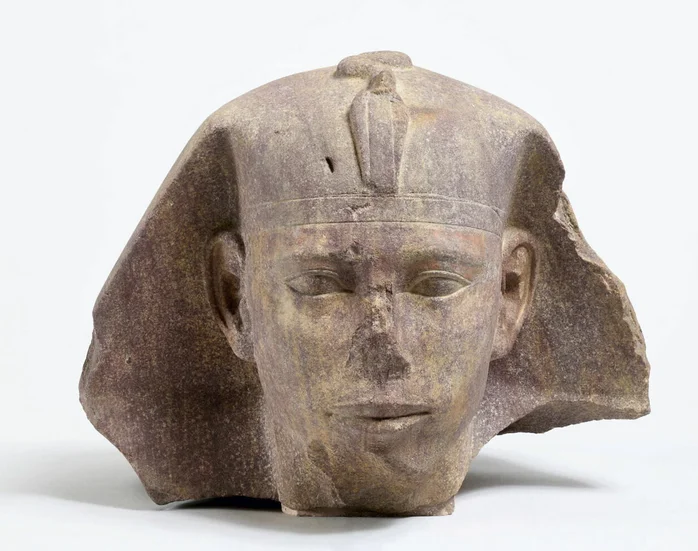
- A King's Face: The most beautiful portraits of Djedefre, including a famous quartzite head now in the Louvre, were found in his pyramid complex, showcasing a new level of realism and sensitivity in royal art.
Legacy: An Idea More Powerful Than Stone
After Djedefre's short reign, the throne returned to Giza with his brother (or half-brother) Khafre. For a long time, historians believed that Djedefre's memory was intentionally suppressed and his pyramid destroyed by his successors as retribution for his "heretical" move to Abu Rawash. However, modern research shows that his pyramid was quarried much later and that his name was respected by his immediate successors.