Definition & Origins
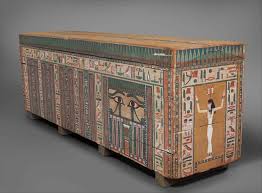
The Coffin Texts are a vast collection of ancient Egyptian funerary spells written in cursive hieroglyphs on the interior surfaces of wooden coffins. Unlike the Pyramid Texts carved in stone for kings, these spells were painted in ink for nobles and officials, serving as a "survival guide" for the soul.
| Time Period | Middle Kingdom (c. 2100–1700 BCE) |
|---|---|
| Primary Medium | Wooden Rectangular Coffins |
| Total Spells | Over 1,185 distinct spells |
| Key Innovation | Maps of the Afterlife |
The Age of Transition
Emerging during the First Intermediate Period and flourishing in the Middle Kingdom, these texts mark a shift in society. Following the collapse of the Old Kingdom's central authority, regional governors and wealthy citizens began to claim the royal privileges of the afterlife. This period is often called the "Democratization of the Afterlife."
A Survival Manual
The Coffin Texts served practical magical purposes for the deceased:
- Protection: Warding off dangers like losing one's head or heart.
- Navigation: Providing passwords to pass gates and ferrymen.
- Provision: Magic spells to create food and water (in case physical offerings ceased).
- Reunion: Ensuring the deceased could reunite with their family in the afterlife.
Inheritance & Adaptation
Many Coffin Texts are direct adaptations of the earlier Pyramid Texts. However, they were "privatized." References to the King were replaced with the name of the deceased (e.g., "The Osiris [Name]"). This was a radical theological shift: now, anyone who could afford the rituals could become an Osiris and achieve eternal life, a status previously reserved for the Pharaoh.
Fears and Hopes
The texts reveal the deep anxieties of the Egyptians. Spells include "Not dying a second death," "Not eating filth," and "Not walking upside down." Conversely, they offer hope through transformation spells, allowing the soul to turn into a falcon, a swallow, a crocodile, or even fire to escape confinement.
The First Map of Heaven
Found on the floor of coffins from Dayr al-Barsha, the Book of Two Ways is the first illustrated map of the afterlife ever created. It depicts two zigzagging paths (one of land, one of water) separated by a lake of fire. It provides a visual guide to navigate the dangerous realm of Rosetau to reach the mansion of Osiris.
Shift to Osiris
While Ra remains important, the Coffin Texts mark the rise of Osiris as the supreme judge of the dead. The deceased is now identified as Osiris. Other prominent deities include Shu (god of air/life) and the Four Sons of Horus, who begin to appear as guardians of the internal organs.
Script of the People
The texts are written in Middle Egyptian, the classical language of literature. They use cursive hieroglyphs, a script that bridges formal hieroglyphs and handwritten hieratic. This script allowed for more text to be packed into the limited space of a coffin's interior compared to carved stone.
The Elite Class
The primary users were provincial governors (Nomarchs), high officials, military commanders, and their families. This reflects the decentralized power of the time. Wealthy women also had coffins inscribed with these texts, indicating that gender was no longer a barrier to high-status afterlife expectations.
Knowledge is Power
The Coffin Texts symbolize the belief that Knowledge (Gnosis) is Salvation. It was not enough to be buried; one had to know the names of the gatekeepers and the geography of the Duat. The coffin itself became a microcosm of the universe, wrapping the deceased in a protective layer of magical knowledge.
Precursor to the Book of the Dead
Just as the Pyramid Texts evolved into the Coffin Texts, the Coffin Texts eventually evolved into the Book of the Dead (Book of Coming Forth by Day) in the New Kingdom. Spell 472 of the Coffin Texts, for example, became Chapter 6 of the Book of the Dead—the famous spell for activating the Shabti figurines to work in the afterlife.
A Religious Revolution
The Coffin Texts represent a profound spiritual democratization. They asserted that the afterlife was not a royal monopoly. They introduced a stronger emphasis on morality and justice (Ma'at) as a prerequisite for eternal life, moving religion from state ritual toward personal piety and ethical accountability.
Unlocking the Middle Kingdom
Modern scholars use these texts to understand the social changes of the Middle Kingdom and the evolution of the Egyptian language. Because they were written on wood (which decays), fewer survive than stone inscriptions, making every discovered coffin a precious time capsule of ancient thought.
Encyclopedia Summary
| Subject | Middle Kingdom Funerary Spells |
|---|---|
| Medium | Wooden Coffins (Interior) |
| Key Innovation | Map of the Afterlife (Book of Two Ways) |
| Key Spell | Spell 1130 (Equality of Man) |
| Legacy | Ancestor of the Book of the Dead |