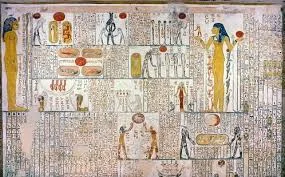
Definition & Origins
The Book of Caverns (Ancient Egyptian: Qererts) is a terrifying and profound funerary text from the New Kingdom. Unlike the solar journey of the Amduat, this book describes the sun god Ra's descent into the deep, static caverns of the earth to judge the dead and revive the mummy of Osiris.
| Type | Underworld Book (New Kingdom) |
|---|---|
| Primary Focus | Punishment & Renewal |
| Structure | 6 Sections (Caverns) |
| Key Location | Osireion (Abydos), KV9 (Ramesses VI) |
The Ramesside Theology
This text rose to prominence during the Ramesside period (19th-20th Dynasties, c. 1300 BCE). It reflects a darker, more judicial theology than earlier texts. It appears most famously in the Osireion at Abydos (the cenotaph of Osiris) and in the spectacular tomb of Ramesses VI in the Valley of the Kings.
Destruction of Chaos
The Book of Caverns served to authorize the total destruction of the enemies of Ra and Osiris. It ensures that the wicked are annihilated so they cannot disrupt the cosmic order (Ma'at), while the righteous (and the King) are granted new bodies and light in the darkness.
The Six Caverns
Instead of hours, the text is divided into six large tableaus or "Caverns," filled with rows of gods and the damned:
| Section | Theme | Key Figure |
|---|---|---|
| 1st Cavern | Entry | Ra enters the West; tribute to Osiris. |
| 2nd Cavern | Submission | Enemies bound; Ra as a Ram. |
| 3rd Cavern | The Corpse | Osiris on his bier; sarcophagi protected. |
| 4th Cavern | Darkness | Mysterious forms in the deep. |
| 5th Cavern | Punishment | The Cauldrons of Hell. |
| 6th Cavern | Rebirth | Ra rises from the Primeval Waters (Nun). |
The Inverted Ones
A terrifying punishment depicted in the text is Inversion. The damned are shown upside down (heads at the bottom). This reversed posture symbolized the total disruption of their senses (digestion, sight, breath) and their exclusion from the natural order of the cosmos. They are denied the ability to ever rise again.
Light in the Darkness
In contrast, the blessed dead (including the King) stand upright. They bow to Ra as he passes and receive clothes, breath, and light. However, salvation is conditional. Ra's light shines on them only briefly as he passes through their cavern; once he leaves, they return to the protective darkness of the earth until his return the next night.
The Ram of Light
Ra appears in this text not as a falcon, but as a ram-headed man (Auf-Ra, "Flesh of Ra"). This form emphasizes his tangible, physical presence in the underworld. He speaks to the inhabitants of the caverns, promising them protection in exchange for their assistance in towing his boat towards the dawn.
The Oval Ovals
The artistic style of the Book of Caverns is unique. The "Caverns" are often depicted as a series of Ovals containing three deities each. This creates a sense of enclosed, subterranean spaces (sarcophagi or womb-like structures). The imagery is dense, crowded, and intentionally claustrophobic, reflecting the pressure of the earth above.
The King as Defender
By inscribing this text in his tomb, the Pharaoh identified himself as the defender of Ra. He claimed the power to command the executioners of the cauldrons, ensuring that he would never fall victim to them. Instead, he would rise with Ra from the arms of Nun in the final cavern.
The Underworld Corpus
The Book of Caverns completes the trilogy of major New Kingdom underworld books (along with the Amduat and Book of Gates). While the Amduat focuses on the river journey and the Book of Gates on passage through barriers, the Book of Caverns focuses on the static states of the dead: the corpse of Osiris waiting to be revived and the enemies waiting to be destroyed.
Deities of the Deep
The text is populated by obscure and terrifying deities found nowhere else, such as:
- The Annihilator: A god guarding the place of destruction.
- The Cat-Headed Goddess: A guardian of the cauldrons (possibly a form of Bastet).
- Aker: The double-lion earth god who guards the entrance and exit of the underworld.
Moral Absolutism
The Book of Caverns symbolizes Moral Absolutism. There is no middle ground. You are either with Ra (and thus exist) or against Ra (and are annihilated). It teaches that the universe cleanses itself every night; darkness is not just an absence of light, but an active force of purification.
Psychology of Hell
Scholars study the Book of Caverns to understand the psychological origins of "Hell" in human thought. It provides the most detailed ancient Egyptian account of what happens to those who fail the moral test of life, offering a stark contrast to the optimistic view of the Field of Reeds.
Encyclopedia Summary
| Subject | Guide to the 6 Caverns of Hell/Rebirth |
|---|---|
| Key Feature | Cauldrons of Punishment |
| Visual Style | Ovals and dense registers |
| Central Theme | Destruction of Enemies vs. Revival of Osiris |
| Unique Element | Inverted (Upside Down) Souls |