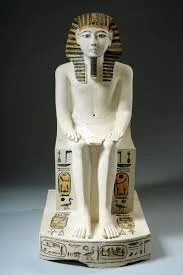
Basic Identity
Amenhotep I (Ancient Egyptian: Amun-hotep, meaning "Amun is Satisfied") was the second pharaoh of the 18th Dynasty. Succeeding his warrior father Ahmose I, he shifted the focus from liberation to consolidation, laying the administrative and religious foundations for Egypt's Golden Age.
| Throne Name | Djeserkare (“Holy is the Soul of Ra”) |
|---|---|
| Dynasty | 18th Dynasty |
| Reign | c. 1525–1504 BCE (Approx. 21 Years) |
| Capital | Thebes (Waset) |
The Stabilizer
Amenhotep I is remembered not as a conqueror, but as an organizer. He healed the scars of the Hyksos war, rebuilding the temples that had fallen into ruin and reorganizing the administration of the reunited kingdom. His reign was a time of peace, art, and the standardization of religious rituals.
Mother and Son
He was the son of Ahmose I and Queen Ahmose-Nefertari. Ascending the throne as a child, he ruled initially under his mother's regency. This partnership was so successful that they were later deified together as the patron gods of the Theban necropolis, worshipped for centuries by the tomb builders.
Securing the South
Though his reign was largely peaceful, he led a campaign into Kush (Nubia) to expand Egypt's borders to the Third Cataract. This secured the gold mines and trade routes vital for the economy. He appointed a "King's Son of Kush" (Viceroy) to administer the region, integrating it fully into the Egyptian state.
Patron of the Artisans
Amenhotep I founded the workers' village at Deir el-Medina (Set Ma'at). This exclusive community housed the skilled artisans who dug and decorated the royal tombs in the Valley of the Kings. Because he provided them with homes and water, they revered him as their local deity, depicting him with black skin (symbol of fertility) on their stelae.
Separating Tomb & Temple
He was the first pharaoh to separate his tomb from his mortuary temple. This was a revolutionary security measure. By hiding his tomb in the cliffs (possibly the first in the Valley of the Kings area) and building his worship temple on the edge of the cultivation, he hoped to protect his mummy from robbers while allowing his public cult to thrive.
The Alabaster Chapel
At Karnak, he commissioned the Alabaster Chapel, a shrine of exquisite beauty designed as a resting place for the sacred barque of Amun. He completely rebuilt the central core of the Karnak temple in limestone, establishing the architectural style that would define the New Kingdom.
Amun's Ascent
Under Amenhotep I, the priesthood of Amun gained immense prestige. He opened the turquoise mines in Sinai solely to adorn the temples. The "Beautiful Festival of the Valley" became a major Theban celebration, linking the king, the god Amun, and the ancestors in a grand procession.
The 'Amenhotep Style'
Art from his reign shows a distinct elegance. The figures are slender, with large eyes and a gentle smile, influencing the artistic canon for generations. Literature also flourished; the "Ebers Papyrus" (a medical text) is dated to his reign, showing the era's intellectual vibrancy.
End of a Line
Amenhotep I died without a surviving male heir. To ensure stability, he likely appointed a capable military commander, Thutmose (who married Amenhotep's sister, Ahmose), as his successor. This peaceful transition to the Thutmosid line prevented civil war and preserved the dynasty's momentum.
The Protected King
His mummy was found in the Deir el-Bahari cache (DB320). Uniquely, it is the only royal mummy that modern Egyptologists have never unwrapped. Its linen wrappings and floral garlands are so perfectly preserved and beautiful that researchers decided to leave him in peace, studying him only via X-ray and CT scans.
Comparison with Ahmose
| King | Ahmose I | Amenhotep I |
|---|---|---|
| Role | Liberator (War) | Consolidator (Peace) |
| Focus | Expelling Hyksos | Building Temples |
| Legacy | Founded Empire | Defined Culture |
📌 Comprehensive Summary
👑 Name: Amenhotep I (Amun is Satisfied)
🕰️ Era: 18th Dynasty (Early)
⚔️ Achievement: Founding Deir el-Medina
🪨 Monument: Alabaster Chapel at Karnak